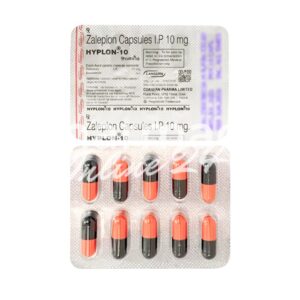
Hypnite

In brief
- Hypnite (eszopiclone) is a prescription-only medicine and is not licensed in the UK.
- Hypnite is used for the short-term treatment of insomnia. Its active ingredient, eszopiclone, is a non-benzodiazepine hypnotic that works by enhancing the effect of gamma-aminobutyric acid (GABA) in the brain, helping to induce and maintain sleep.
- The usual dose for adults is 2–3 mg taken at bedtime; elderly patients usually start at 1 mg, with a maximum of 2 mg. The maximum adult dose is 3 mg per day.
- Hypnite is taken by mouth as tablets, commonly available in 1 mg, 2 mg, and 3 mg strengths.
- It usually starts to work within about 30 minutes, so it should be taken only when you are ready to go to sleep.
- The duration of action is typically around 6–8 hours, which may cause next-day drowsiness in some people.
- Do not drink alcohol when taking Hypnite, as alcohol can greatly increase sedation, impair coordination, and raise the risk of dangerous breathing problems and complex sleep behaviours.
- The most common side effects include a bitter or metallic taste, dry mouth, headache, dizziness, somnolence, and next-day drowsiness.
- Would you like to try Hypnite without a prescription?
What Hypnite is and who it is for
- INN (international nonproprietary name): eszopiclone
- ATC code: N05CF04
- Forms and dosages: tablets, 1 mg, 2 mg, 3 mg
- Registration status in the United Kingdom: Not licensed in the UK
- OTC / Rx classification: Prescription-only medicine (POM)
Hypnite as a brand name for eszopiclone
Hypnite is a brand name for eszopiclone, a non-benzodiazepine hypnotic drug in the sedative-hypnotic group.
In pharmacy terms, it is a prescription insomnia treatment rather than a general wellness product.
The medicine is identified in the ATC system as N05CF04, and the standard strengths are 1 mg, 2 mg, and 3 mg.
In a UK pharmacy setting, the main questions are always the same: who prescribed it, what strength was issued, and whether it is suitable for this patient.
When UK patients are typically prescribed a sleeping tablet
Sleeping tablets are generally considered when insomnia is causing real distress and sleep hygiene measures have not been enough.
A GP or private prescriber may consider a hypnotic drug such as eszopiclone when the problem is short-lived, severe, and affecting daytime functioning.
That might be after acute stress, travel disruption, or a temporary flare in sleep difficulties.
Pharmacists will usually be cautious with repeat requests, because ongoing insomnia needs review rather than endless refills.
Legal status and availability in the UK
Hypnite (eszopiclone) is a prescription-only medicine (POM) and is not licensed in the UK.
In our online pharmacy, Hypnite is available without a prescription, with discreet delivery to the United Kingdom in 9–21 days.
Pharmacist checks
A pharmacist checks the strength, dose instructions, interactions and suitability before supply.
This is especially important with hypnotics, because the wrong dose or the wrong timing can create next-day drowsiness or unsafe sedation.
Strengths and tablet packaging
Hypnite is supplied as tablets only, with standard strengths of 1 mg, 2 mg, and 3 mg.
Blister strips of 10, 14, or 30 tablets are typical. No liquid or injectable form is standard.
Check the exact strength, tablet count and branding against the prescription. A patient prescribed 2 mg should not receive a different strength by mistake, and strengths are not interchangeable unless the prescriber says so.
Standard dosing for insomnia in adults and older patients
Typical adult bedtime dose
For adults with insomnia, the usual bedtime dose is 2–3 mg at bedtime, with a maximum adult dose of 3 mg per day.
That means this is a sleeping tablet to be taken when sleep is intended, not something to use in the middle of the day.
The timing matters because the medicine can impair alertness and functioning if taken too late or when a full night’s sleep is not possible.
Elderly starting dose and maximum dose
Older adults are started more cautiously.
The usual starting dose is 1 mg at bedtime, with a maximum of 2 mg.
That lower approach reflects the greater sensitivity many older patients have to sedative effects and the higher risk of falls, confusion, and residual drowsiness.
Why dose timing matters more than daytime convenience
A sleeping pill dose is not chosen for the easiest time of day.
It is chosen for the safest bedtime window.
Patients sometimes ask whether they can take it earlier “to get ahead of the night”, but the practical answer is that the dose should only be used when sleep can follow.
Adult and elderly dose comparison
| Patient group | Usual bedtime dose | Maximum dose |
|---|---|---|
| Adults | 2–3 mg | 3 mg/day |
| Elderly | 1 mg | 2 mg |
Dose adjustments, special populations, and when not to use it
Children and adolescents
For children, safety and efficacy are not established.
That means use is not recommended.
Any request for a younger patient needs careful prescriber review rather than routine supply.
Hepatic and renal impairment
Liver and kidney function both matter when a hypnotic is being considered.
In hepatic impairment, the dose should not exceed 2 mg per night, and the initial dose is 1 mg for elderly patients or those with liver impairment.
In renal impairment, no major adjustment is usually needed, but the lowest effective dose should be used.
That is a classic pharmacist screening point, especially when an older patient has several long-term conditions.
Pregnancy, breastfeeding, and frailty
Pregnancy and breastfeeding call for caution and prescriber judgement.
Use is only advised if it is clearly necessary.
Frailty, recurrent falls, memory problems, and multiple sedating medicines all raise the risk of harm, so a pharmacist may pause supply until the prescription is clarified.
Use guidance terms
- Use not recommended
- Children and adolescents, because safety and efficacy are not established.
- Caution
- Pregnancy, breastfeeding, frailty, hepatic impairment, renal impairment, and older age.
- Monitor closely
- Patients with multiple medicines, daytime sedation, or a history of falls or confusion.
How long treatment should last and why short-term use matters
Short-term insomnia treatment only
People often hope a sleeping pill will solve the problem for good.
In reality, Hypnite is intended for short-term treatment only, generally 2–4 weeks.
That short window is important because insomnia is often temporary, and the medicine is not designed as a chronic daily solution without re-evaluation.
Tolerance, dependence, and review points
With prolonged use, tolerance and dependence risk increase.
That is one reason repeat requests need review.
Regular review matters because the underlying cause of insomnia may need attention, whether that is stress, pain, medication timing, alcohol use, or an untreated sleep disorder.
When a pharmacist may advise reassessment
If a patient is asking for more tablets than expected, sleeping badly despite treatment, or using a sedative-hypnotic most nights for weeks on end, reassessment is sensible.
Sometimes the better answer is not another box, but a review of the cause and a safer long-term plan.
2–4 week review timeline
| Time point | What to review | Why it matters |
|---|---|---|
| Week 2 | Response, next-day drowsiness, adherence | Checks whether the dose is working safely |
| Week 4 | Need for continued treatment | Helps reduce dependency risk |
How to take Hypnite correctly at night
Bedtime use and next-day functioning
Want the simple rule?
Take it at bedtime, and only when there is enough time for sleep afterwards.
Because next-day drowsiness can happen, the patient should be warned not to drive or do tasks requiring full alertness if they still feel sedated in the morning.
Food, alcohol, and other sedatives
Alcohol and other CNS depressants increase the chance of excessive sedation.
That includes other sleep medicines or strong sedatives unless a prescriber has specifically advised the combination.
Sleep hygiene advice still matters too, because a tablet works better when the basics are in place: regular bedtimes, less late-night caffeine, and a calm wind-down routine.
What to do if sleep does not come immediately
If sleep is slow to arrive, the patient should not keep taking extra tablets during the night.
That is a common and risky mistake.
- Take the prescribed dose only at bedtime.
- Do not combine it with alcohol or other sedatives unless specifically instructed.
- Allow enough time for sleep before getting up again.
- Do not repeat the dose if sleep is delayed.
- Use sleep hygiene measures alongside the medicine.
Missed dose and overdose guidance
If a dose is forgotten
If a dose is missed, the patient should skip it and not double up.
It should not be taken outside the bedtime window to “catch up”.
Signs of overdose or excessive sedation
Too much medicine can cause excessive sedation, poor coordination, and dangerous slowing of breathing.
That is why a pharmacist will ask about what else has been taken, especially alcohol, opioids, or other sedating medicines.
When to seek emergency help
If there is concern about overdose, urgent medical help is needed straight away.
Emergency symptoms and actions
- Unusual sleepiness or hard-to-wake behaviour
- Very slow or difficult breathing
- Confusion or collapse
- Call emergency services immediately
Common side effects
Mild effects: metallic taste, dry mouth, headache
The first thing many patients notice is not dramatic, but annoying.
A metallic taste, dry mouth, headache, somnolence, or dizziness can make the next morning feel off.
That may be enough to put someone off continuing, even if the sleep itself improved.
Moderate effects: drowsiness, memory issues, coordination problems
Some effects are more disruptive.
Next-day drowsiness, memory disturbance, and impaired coordination can affect work, driving, and confidence the following day.
These are the kinds of problems pharmacists listen for when patients call back after starting treatment.
Parasomnias and why they matter
Parasomnias are the safety issue that stands out most.
Sleepwalking, eating, or driving while not fully awake are serious warning signs and should never be brushed off as just a “strange side effect”.
If they happen, the medicine needs review promptly.
Common side effects by urgency
| Severity | Examples | What to do |
|---|---|---|
| Mild | Metallic taste, dry mouth, headache | Monitor and mention at review |
| Moderate | Drowsiness, memory disturbance, impaired coordination | Use caution, especially with driving |
| Urgent | Sleepwalking, eating, driving while not fully awake | Stop and seek medical advice |
Contraindications and safety warnings
Absolute contraindications
Some situations mean the medicine should not be supplied without clear prescriber direction.
- Absolute contraindications
- Known hypersensitivity to eszopiclone or excipients, history of complex sleep behaviour, and severe hepatic impairment.
- Relative contraindications
- Respiratory depression or severe sleep apnoea, substance abuse or alcoholism, depression or suicidal ideation, pregnancy, and breastfeeding.
- Pharmacist consultation
- Essential when the history suggests risk, because hypnotics can worsen sedation or abnormal sleep behaviour.
Relative contraindications and caution groups
Sleep apnoea and other breathing problems are particularly important because sedatives can make respiratory issues worse.
History of substance misuse, low mood, or suicidal thoughts also deserves careful screening.
Those are not box-ticking questions; they are core safety checks.
Why previous sleepwalking history matters
Previous complex sleep behaviour is a major red flag.
If a patient has already sleepwalked, driven, or done other activities while not fully awake on a similar medicine, that history needs to be taken seriously before any further supply.
That is one of the clearest reasons why pharmacist screening is essential before Hypnite is supplied.
Hypnite versus other sleeping tablets and alternatives
Hypnite compared with zopiclone and zolpidem
Hypnite is often compared with zopiclone and zolpidem.
That is understandable, because all of these are used in insomnia and sit close together in the non-benzodiazepine, Z-drug family.
Zolpidem and zopiclone are the best-known comparators, but they are not identical products and cannot be assumed to be interchangeable without prescriber approval.
Where benzodiazepines fit, if at all
Benzodiazepines are part of the wider insomnia discussion, but they raise their own safety and dependency concerns.
The key point is simple: a “stronger” sleeping tablet is not automatically a better one.
The right choice depends on the patient’s age, other medicines, breathing problems, and whether the problem is truly short-term.
Comparison of common alternatives
| Medicine | Class | Typical use | Pharmacy note |
|---|---|---|---|
| Eszopiclone | Non-benzodiazepine hypnotic | Insomnia | Bedtime-only, short-term use |
| Zolpidem | Z-drug | Insomnia | Similar counselling needed |
| Zopiclone | Z-drug | Insomnia | Common comparator in the UK |
| Benzodiazepines (e.g. temazepam) | Benzodiazepine | Insomnia | Higher caution with dependence |
Storage
Storage temperature and packaging protection
Good storage keeps medicine stable and easy to identify.
Hypnite should be stored at 15–30°C, in the original packaging, away from moisture and direct sunlight.
It should not be refrigerated or frozen.
Carrying the medicine home
When a patient collects a medicine from a pharmacy, the simplest advice is to keep it dry, avoid leaving it in a hot car, and keep the blister pack intact until use.
That helps protect the tablets and makes it easier to check the batch and expiry date later.
Delivery across the United Kingdom
| City | Region | Delivery time |
|---|---|---|
| London | England | 9–21 days |
| Birmingham | England | 9–21 days |
| Manchester | England | 9–21 days |
| Liverpool | England | 9–21 days |
| Leeds | England | 9–21 days |
| Sheffield | England | 9–21 days |
| Bristol | England | 9–21 days |
| Newcastle upon Tyne | England | 9–21 days |
| Nottingham | England | 9–21 days |
| Leicester | England | 9–21 days |
| Cardiff | Wales | 9–21 days |
| Edinburgh | Scotland | 9–21 days |
| Glasgow | Scotland | 9–21 days |
| Belfast | Northern Ireland | 9–21 days |
For safe use, keep the pack protected, follow the prescription carefully, and never combine the medicine with alcohol or other sedating medicines unless a prescriber has said it is appropriate.