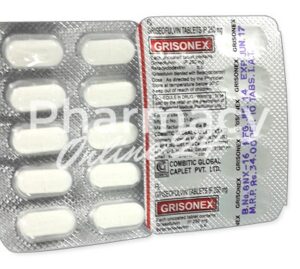
Fulvicin
In stock
250mg
from 24,55 £
In brief
- Fulvicin is a griseofulvin product used when ringworm, a dermatophyte infection, affects the skin, scalp, hair or nails and simpler treatment is not enough.
- One strength, 250 mg, is offered, with 30, 60, 90, 120, 180 or 360 tablets per pack.
- Griseofulvin is POM in the UK, licensed as 125 mg and 500 mg tablets, so this Fulvicin is an imported product.
Fulvicin and the fungi that respond to griseofulvin
Fulvicin is imported, and the substance inside is griseofulvin, one of the oldest antifungal medicines. After it is absorbed it collects in keratin, the protein that makes up skin, hair and nails, and makes newly formed keratin resistant to the fungus. The infected tissue is gradually replaced by healthy growth, so a course takes weeks or months and nothing clears overnight. Its reach is narrow, covering dermatophytes only. Candida, Aspergillus and Malassezia furfur (the cause of pityriasis versicolor) do not respond, nor does Nocardia, so Fulvicin is no use for thrush or for that type of skin rash.
Where griseofulvin is indicated
According to the UK SmPC, griseofulvin is for tinea of the skin, scalp, hair and nails that is widespread, or in which a cream or lotion cannot be used or has failed. Doctors normally confirm the diagnosis first by examining a scraping, hair or nail clipping, because many red, scaly rashes have other causes and gain nothing from an antifungal tablet. Prevention is not a use.
Dose and duration for the 250 mg tablet
Adults take 500 to 1,000 mg daily, which means two to four tablets, either together or in divided doses; the figure should never fall below 10 mg per kg of body weight. The dose for children is 10 mg per kg daily in divided portions. A meal containing fat helps absorption, so the tablets are ideally taken after a meal. Skin and hair infections need at least four weeks, while nail infections need six to twelve months, and in every case treatment carries on for two weeks after the infection seems to have gone. Normal-looking skin after a fortnight proves nothing, and stopping early is a common reason for a relapse.
Situations in which griseofulvin is ruled out
Pregnancy, porphyria, severe liver disease, systemic lupus erythematosus and hypersensitivity to the drug are all contraindications. Women must avoid pregnancy during treatment and for a month afterwards. Men are advised to wait six months after the last dose before fathering a child and not to do so while on treatment.
Contraceptives, anticoagulants and other interactions
Griseofulvin can make the oral contraceptives less dependable, so an additional barrier method is recommended throughout the course and for one month after it. It reduces the effect of warfarin-type anticoagulants and ciclosporin, while phenobarbital and similar enzyme inducers weaken griseofulvin itself. Alcohol is poorly tolerated by some people on the drug. Because the list of possible interactions is longer than most people expect, a doctor or pharmacist should hear about Fulvicin before anything new is started.
Why finishing the course is important
Griseofulvin protects only keratin that grows after the dose has been absorbed. In a child with scalp ringworm, for instance, weeks of daily tablets may pass before hair emerges free of fungus. Skipped doses give surviving spores a chance to grow again, and that is when a rash comes back. If the rash is not improving or is spreading, return to the prescriber, since the diagnosis may need rethinking.
Side effects and the UK picture
Adverse reactions on record range from stomach upset, headache, rash and hives to dizziness, confusion, poor coordination, peripheral neuropathy, abnormal liver tests and a fall in white cells. Skin can become sensitive to sunlight, so cover up or use sunscreen, and serious skin reactions can occur. In Britain griseofulvin is supplied only on prescription. On the electronic medicines compendium only 125 mg and 500 mg griseofulvin tablets appear; Fulvicin has no entry, so the imported pack described here is a different product. Fulvicin is a matter for the prescriber to judge, including how long to continue it given the type and site of infection and the patient’s other medicines.