Clomid
In brief
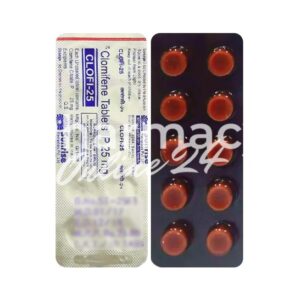
- Clomid (clomifene) can be ordered from Pharmacy Online 24 in 25mg or 50mg tablets, 10 to 360 per pack, and in 100mg tablets, 10 to 180 per pack, with UK delivery in 9–21 days.
- The drug blocks oestrogen receptors in the brain, so the pituitary raises FSH and LH output and the ovaries are prompted to release an egg, which helps when infertility is down to infrequent or absent ovulation.
- The 50mg tablet is the only UK-licensed strength, so 25mg and 100mg are not; the first tablet is normally taken between day two and day five, and a luteal-phase progesterone blood test shows if ovulation happened.
- It is unsuitable with liver disease, unexplained uterine bleeding or ovarian cysts unrelated to PCOS, and the number of cycles is capped because of concerns about the ovaries over the long term.
- Lower abdominal pain with bloating can mean ovarian overstimulation, visual blurring needs urgent review, and multiple births are more common. It is a POM.
Basic Clomid information
- INN (international nonproprietary name): Clomifene
- Brand names available in the United Kingdom: Clomid; generic clomifene citrate tablets
- ATC code: G03GB02
- Forms and dosages: Oral tablets, 50 mg
- Manufacturers in the United Kingdom: Sanofi and generic suppliers
- Registration status in the United Kingdom: Prescription-only medicine (POM)
- OTC / Rx classification: Prescription-only medicine (POM)
Clomid is a brand of clomifene (clomifene citrate), a tablet used for fertility treatment.
Clomid is the same medicine as clomifene citrate; clomifene is the International Nonproprietary Name (the US spelling is clomiphene).
In the UK, Clomid is supplied as 50 mg tablets, usually taken for 5 days at the start of the cycle.
Legal status and availability in the UK
Clomid (clomifene) is a prescription-only medicine (POM) in the UK.
In our online pharmacy, Clomid is available without a prescription, with discreet delivery to the United Kingdom in 9–21 days.
What Clomid is used for
| Use | Who it may suit | Usual pattern | Notes |
|---|---|---|---|
| Ovulatory failure / anovulation | Adults with infertility linked to ovulation problems | 50 mg daily for 5 days, starting days 2–5 of the cycle | Standard indication for ovulation induction |
| PCOS-related ovulation induction | Adults with polycystic ovary syndrome under monitoring | Same cycle-based approach | Needs caution because of hyperstimulation risk |
| Male infertility / hypogonadism | Men under specialist supervision | 25–50 mg daily, titrated to response | Off-label use |
| Children | Not suitable | Not indicated | Safety and efficacy are not established |
The main licensed use is ovulatory failure or anovulation in infertility care, usually as a 5-day course started early in the cycle.
The dose is simple, but the timing matters.
Off-label male fertility use exists, but it should only happen under medical supervision and with proper monitoring.
It is not used in children, and use in older adults is uncommon.
In PCOS, Clomid may be relevant, but it is not a casual hormone-balancing tablet.
How Clomid works in the body
Clomifene is a selective oestrogen receptor modulator.
In simple terms, it can encourage the body to trigger ovulation by changing how oestrogen signals are interpreted.
That is why it is classed as an ovulation stimulant, synthetic, with ATC code G03GB02.
For a fertility cycle, the timing of tablets is important because the medicine is used to support ovulation at a specific point, not as an everyday hormone regulator.
This is also why follow-up matters between cycles.
A prescriber may want to check whether ovulation is occurring, whether side effects are manageable, and whether another cycle is appropriate.
ATC code and therapeutic class
The ATC code G03GB02 places clomifene in the group for sex hormones and modulators of the genital system.
Its therapeutic role is as a synthetic ovulation stimulant.
Why timing within the menstrual cycle matters
Most prescriptions begin on days 2 to 5 of the cycle and run for 5 days.
That cycle-based dosing is one reason patients often keep a written calendar or app note for each fertility tablet course.
Who can and cannot take Clomid
Is this medicine suitable, or is there a reason to avoid it?
That is the right question to ask before supply, because fertility medicine safety matters as much as access.
- Do not use: if you are pregnant, have liver disease or abnormal liver function, unexplained uterine bleeding, ovarian cysts not due to polycystic ovary syndrome, pituitary or other hormone-dependent tumours, or a known allergy to clomifene or tablet components.
- Use extra caution: if you have PCOS, a fibroid uterus, visual disturbances during treatment, thromboembolic risks, or renal impairment.
Severe hepatic dysfunction is a clear no-use area.
PCOS is not an automatic stop, but it does need monitoring because of ovarian hyperstimulation risk.
Visual symptoms should always be taken seriously, and any persistent change needs review.
For people with a history of clots, the prescriber may want a more careful risk assessment before treatment starts.
How Clomid is usually prescribed
| Condition | Initial dose | Maximum dose | Typical regimen |
|---|---|---|---|
| Ovulatory failure / anovulation | 50 mg/day | Up to 150 mg/day | 5 days, starting days 2–5 of the cycle |
| Male infertility / hypogonadism | 25–50 mg/day | Titrated to clinical response | Physician-monitored use |
For ovulation induction, 50 mg daily is the standard starting point.
Dose escalation may be considered if response is inadequate, but the maximum is generally 150 mg/day.
More is not better, and longer treatment is not automatically safer or more effective.
For men, the off-label dose range is lower and must be supervised.
Children are not treated, and older adults are not routine candidates.
First-Line dosing for ovulation induction
The usual first course is 50 mg daily for 5 days.
Scored tablets may be useful if the prescriber needs a split dose, but the exact plan should come from the prescription.
Dose changes, titration and maximum exposure
If treatment is continued, the dose may be adjusted up to 150 mg/day in selected cases.
Extended use beyond six cycles is generally avoided because of risk concerns, including ovarian tumours with prolonged exposure.
Treatment duration, repeat cycles and when to stop
How long should a course last, and when should it be reviewed?
The usual pattern is a 5-day course that may be repeated across cycles, with up to 6 cycles commonly referenced.
- Take the medicine only for the days prescribed.
- Keep track of each cycle start date.
- Arrange follow-up if ovulation is not happening.
- Stop and seek review if side effects become troublesome.
Repeat prescriptions often need fertility clinic input, GP review, or private prescriber sign-off.
That continuity matters because response, tolerability, and timing all affect the next step.
How to take Clomid correctly in everyday use
- Swallow the tablets by mouth exactly as prescribed.
- Start on the cycle days given by the prescriber, usually days 2 to 5.
- Record each dose day so there is no confusion later in the cycle.
- If a dose is missed, take it as soon as remembered unless it is nearly time for the next dose.
- Do not double up to make up for a missed tablet.
- If the cycle instructions are unclear, contact the pharmacist or clinic before taking the next dose.
That is especially useful for patients using 25 mg or 50 mg tablets, or scored tablets when splitting is prescribed.
Clear cycle tracking helps avoid accidental overuse and keeps treatment safer.
What to expect during treatment
| Effect | How common it is | What patients often notice |
|---|---|---|
| Ovarian enlargement or discomfort | Common, 8–13% | Pelvic heaviness or ache |
| Hot flushes | Common | Brief waves of warmth |
| Abdominal or pelvic bloating | Common | Feeling puffy or uncomfortable |
| Nausea or vomiting | Common | Stomach upset |
| Headache | Common | Pressure or pain in the head |
| Visual disturbances | Uncommon, up to 2% | Blurred vision or spots |
| Breast discomfort | Occasional | Tenderness or soreness |
| Mood changes | Occasional | Feeling more irritable or emotional |
| Multiple pregnancy | About 8–10% of successful cycles | Higher chance than natural conception |
Many people notice little apart from the cycle itself, while others feel the medicine more clearly.
Short-term symptoms are often mild, but they should still be reported if they affect day-to-day life.
Common, usually mild effects
Hot flushes, bloating, headache, nausea, and ovarian discomfort are the most common patient reports.
These may settle as the course ends, but they can still be unpleasant during treatment.
Symptoms that need prompt medical advice
Blurred vision, spots, marked pelvic pain, or anything that feels out of proportion should be checked quickly.
Multiple pregnancy is not rare enough to ignore, so ovulation monitoring is important.
Serious risks, red flags and when urgent help is needed
Warning: severe ovarian hyperstimulation syndrome is rare, but it is a serious safety issue.
Persistent visual disturbance, such as blurred vision or spots, means the medicine should be stopped and reviewed.
Immediate medical attention is needed for overdose symptoms, including nausea, vomiting, visual disturbance, and ovarian enlargement.
This is the point where self-management ends and urgent clinical advice begins.
If abdominal pain becomes severe, if symptoms worsen rapidly, or if sight changes do not clear, seek help without delay.
Clomid, PCOS and fertility planning in practice
| PCOS scenario | How Clomid fits in | Why monitoring matters |
|---|---|---|
| Ovulation not happening regularly | May be used for ovulation induction | Checks whether treatment is working |
| Higher response risk | Use with caution | Lower threshold for ovarian enlargement and discomfort |
| Fertility planning after investigations | Often prescribed after assessment, not casually | Scans and review may be needed |
| Adjunct planning | May sit alongside lifestyle measures or metformin | Part of a wider fertility plan |
PCOS is a common fertility scenario, but it is also a relative contraindication because of hyperstimulation risk.
That is why clomifene is associated with monitored cycle care rather than general hormone balancing.
In UK practice, it is usually prescribed after fertility investigations.
Clomid for men
- When clinicians consider it
- Off-label use may be considered in male infertility or hypogonadism under specialist care.
- Usual dose range
- 25–50 mg daily, titrated according to clinical response.
- Why supervision is needed
- Blood test monitoring and investigation of the underlying cause are important.
- What to expect
- It is not a routine self-start fertility medicine and should not be treated like an over-the-counter product.
Male use exists, but the decision belongs with a clinician who is reviewing the full picture.
That usually means specialist follow-up.
Clomid alternatives
| Option | How it is used | Practical trade-off |
|---|---|---|
| Letrozole (Femara) | Ovarian stimulator, increasingly used off-label | Another oral option, often discussed as a Clomid alternative |
| Gonadotropins (FSH, HMG) | Injectable ovulation induction | More monitoring and handling burden |
| Metformin | Adjunct in PCOS | Used alongside fertility planning rather than replacing it |
Oral fertility drugs are generally simpler to use than injections, but injections may be chosen when a different response is needed.
Prescription status, storage and anti-doping
| Point | What to know |
|---|---|
| Prescription status | Clomid is a prescription-only medicine (POM) in the UK. |
| Storage | Store below 25°C in a dry place. |
| Handling | Keep out of reach of children and do not use after expiry. |
| Athlete safety | Clomifene is on the WADA Prohibited List. |
Clomid is prescription-only and needs prescriber review and the right clinical context.
Storage is straightforward: keep the tablets below 25°C in a dry place, and do not use them after the expiry date.
Athletes should also note that clomifene is on the World Anti-Doping Agency’s Prohibited List, so clearance is essential before any use.
Delivery across the United Kingdom
| City | Region | Delivery time |
|---|---|---|
| London | England | 9–21 days |
| Birmingham | England | 9–21 days |
| Manchester | England | 9–21 days |
| Leeds | England | 9–21 days |
| Liverpool | England | 9–21 days |
| Glasgow | Scotland | 9–21 days |
| Edinburgh | Scotland | 9–21 days |
| Cardiff | Wales | 9–21 days |
| Belfast | Northern Ireland | 9–21 days |
| Sheffield | England | 9–21 days |
| Bristol | England | 9–21 days |
| Newcastle upon Tyne | England | 9–21 days |
| Nottingham | England | 9–21 days |
| Leicester | England | 9–21 days |
Final points to keep in mind
Clomid is a prescription fertility medicine used mainly for ovulation induction, with clomifene tablets being the standard oral form.
Used correctly, it can be part of a monitored treatment pathway.
Used without review, it can create avoidable risks, especially in PCOS, pregnancy, liver disease, or when visual symptoms appear.
If there is any uncertainty about eligibility, dose, or timing, speak to a pharmacist or prescriber before starting the next cycle.