Verapamil HCl
In stock
40mg · 120mg
from 14,98 £
In brief
- Verapamil HCl is a calcium channel blocker prescribed for raised blood pressure, angina and fast heartbeats originating above the ventricles.
- Pack sizes are 60, 90, 120 or 270 for the 40 mg strength, and 30, 60, 90, 120 or 270 for 120 mg.
- It is a POM in the UK; the listing does not state whether these imported tablets are standard or modified release.
Verapamil HCl and calcium in heart and arteries
Verapamil HCl is the hydrochloride salt of verapamil. Calcium has to enter heart muscle cells and the smooth muscle of artery walls before either can contract, and verapamil narrows that doorway. The arteries widen, the heart works against less resistance and uses less oxygen, and impulses crossing the AV node travel more slowly. The UK SmPC applies this to mild or moderate hypertension, to angina (stable, vasospastic and unstable forms) and to supraventricular arrhythmias. In the last group verapamil can terminate a run of paroxysmal supraventricular tachycardia, help prevent a recurrence, or control the pulse in atrial fibrillation and flutter.
Which tablet is in the pack?
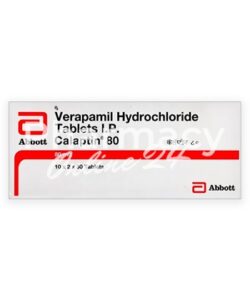
Imported stock raises a practical question: does a 120 mg tablet release verapamil immediately or slowly over many hours? The listing is silent. The answer decides how many doses a day are taken and whether the tablet may be divided, so the prescriber or pharmacist needs to inspect the real box before a dose is chosen or one product is swapped for another. The two Verapamil HCl strengths are 40 mg and 120 mg, in the pack sizes given above.
Verapamil HCl dosing for standard tablets
Hypertension starts at 120 mg twice a day, can move to 160 mg twice a day, and tops out at 480 mg daily split into doses. In angina 120 mg three times a day is usual; 80 mg three times a day may be enough when pain follows exertion, whereas vasospastic angina seldom responds to less than 120 mg three times a day. Rhythm disorders are treated with 40 to 120 mg three times daily. Elderly patients take the standard adult dose unless the kidneys or liver are impaired, and with liver impairment the starting dose is lower and increased gradually. These schedules do not transfer to modified-release tablets.
People who cannot take it
Verapamil HCl depresses conduction and contractility, so it is unsuitable for a heart that is already slow or weak. Contraindications in the SmPC include cardiogenic shock, a complicated acute myocardial infarction, second- and third-degree AV block, sino-atrial block, sick sinus syndrome with no pacemaker, uncompensated heart failure, a pulse under 50 and systolic pressure under 90. Also barred are porphyria and atrial flutter or fibrillation that is passing down an accessory pathway, which is the situation in Wolff-Parkinson-White syndrome. Taking intravenous dantrolene, ivabradine or grapefruit juice alongside it is prohibited.
Metabolism and drug combinations
CYP3A4 breaks verapamil down, and verapamil in turn slows that enzyme. Raised verapamil levels are seen with erythromycin, clarithromycin, ketoconazole and ritonavir, and lowered levels with rifampicin and phenytoin. Higher concentrations of carbamazepine, digoxin, ciclosporin, dabigatran and alcohol have been recorded, statins call for care, and beta-blockers or other rhythm drugs can add to the effect on the heart.
Everyday effects and British licensing
Constipation is the typical complaint. Flushing, swollen ankles and a drop in blood pressure follow in frequency, and large doses may cause a slow or uneven beat or heart failure. Less commonly come headache, dizziness, nausea and fatigue; thickened gums are very rare and clear up once the tablets stop. In Britain modified-release products such as Securon SR are licensed, as are an oral solution and an injection, each available on prescription only. Fainting, severe breathlessness or an unusually slow pulse should be acted on at once. Starting, changing or stopping Verapamil HCl is a decision for the prescriber.