Ciprodex
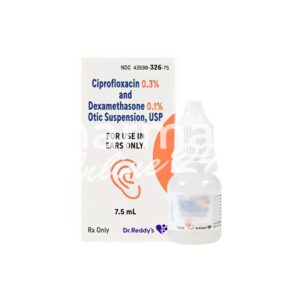
In stock
0.3/0.1%
from 27,52 £
In brief
- Ciprodex combines an antibiotic, ciprofloxacin 0.3%, and a steroid, dexamethasone 0.1%, in one bottle of ear drops.
- It is listed as 0.3/0.1% bottles, ordered singly or in sets of 2, 3, 4, 5 or 6.
- The closest UK equivalent is a prescription-only ear-drop suspension for outer-ear infection; your prescriber decides if it is right.
Ciprodex ear drops and the infection they target
Ciprodex is an ear-drop suspension in which two medicines share one bottle. Ciprofloxacin is a fluoroquinolone antibiotic that acts on the bacteria most often involved in acute otitis externa, commonly called swimmer’s ear, such as Pseudomonas aeruginosa and Staphylococcus aureus. Dexamethasone is a corticosteroid that settles the swelling, redness and pain in the ear canal. The strengths of 0.3% and 0.1% correspond to the 3 mg/ml and 1 mg/ml described in the UK product information. The drops treat the outer ear canal only and are not a remedy for general earache.
What is offered and how it relates to UK licensing
The listing covers 0.3/0.1% bottles, which can be ordered as 1, 2, 3, 4, 5 or 6. Look up Ciprodex on the electronic medicines compendium and no UK product carries that name. What the UK does have is ciprofloxacin 3 mg/ml with dexamethasone 1 mg/ml as an ear-drop suspension, supplied as a prescription-only medicine (POM). Because this bottle is an imported product, read the label for both ingredients and their strengths, and check the expiry date, before the first use.
Dose and technique per the SmPC
Ciprodex follows the UK schedule: from one year of age upwards, four drops go into the sore ear in the morning and again in the evening for seven days. The kidneys, the liver and advancing age call for no adjustment. Give the bottle a good shake, then warm it between your palms for a couple of minutes, because cold liquid in the ear can make you giddy. Lie with the sore ear facing upwards, put the drops in, and stay like that for about five minutes so they reach the canal. Wipe the tip clean and do not let it touch the ear, fingers or any surface.
Who must not use it
The SmPC contraindicates the drops in anyone allergic to ciprofloxacin, to other quinolones, to dexamethasone or to any ingredient in the bottle. They are also unsuitable for viral infections of the outer ear, including herpes simplex and chickenpox, and for fungal ear infections, since a steroid can let these flare. In pregnancy the drops should be used only if clearly needed, and breastfeeding is a point to raise with the prescriber. If you know of a burst eardrum or have grommets, say so first, because the choice of ear drops then needs more thought.
What the ear may feel afterwards
Local reactions to the drops lead the list. Ear pain, itching, a feeling of fullness, a rash around the ear or a sticky residue on the skin can occur, and the SmPC puts ear pain at roughly one user in a hundred. Stop the drops and contact a doctor if tendon pain or swelling develops; contact a doctor if blurred vision or other visual disturbances occur. Signs of an allergic reaction, such as a spreading rash or swelling of the face, need urgent medical help.
When the drops are not working
A course is meant to last a week. If the ear is no better after that, or if discharge keeps returning, the cause may be something other than a simple infection: a foreign body in the canal, a cholesteatoma or a growth can all be responsible. The SmPC advises reassessment when symptoms persist after one week or when the problem keeps recurring. Do not extend the course on your own or share the bottle with someone else. Your GP or prescriber decides whether Ciprodex or a similar medicine is the right choice for your ear.