Inspra
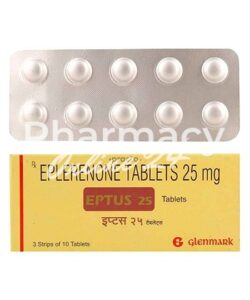
In stock
25mg · 50mg
from 73,65 £
In brief
- Inspra contains eplerenone, an aldosterone-blocking medicine given on top of standard heart-failure treatment, including after a recent heart attack.
- Choose 25 mg or 50 mg, with 30, 60, 90, 120 or 180 tablets in a pack.
- Eplerenone is POM in the UK and licensed as Inspra and as generics; the tablets listed here are imported.
What Inspra does to aldosterone signalling
Inspra’s active ingredient is eplerenone, which occupies the mineralocorticoid receptor so that aldosterone cannot switch it on. Aldosterone tells the kidneys to retain sodium and water and to let potassium go, and in heart failure it also contributes to stiffening and scarring of the heart muscle. Taking that signal away eases the burden on a weakened heart. Eplerenone is an extra layer of treatment, never a substitute for the other heart-failure medicines.
Who the licence is written for
The UK SmPC describes two groups of adult patients. The first has had a recent myocardial infarction, with a left ventricular ejection fraction of 40% or less and clinical signs of heart failure; for them eplerenone is added to optimal therapy, beta-blockers included, to cut the chance of cardiovascular death and of admission to hospital. The second group has long-standing NYHA class II heart failure, with the ejection fraction at 30% or lower. Inspra is therefore not a general diuretic and not an everyday blood pressure treatment.
From 25 mg to 50 mg
Each strength is available in 30, 60, 90, 120 or 180. Inspra dosing begins at 25 mg once daily and aims for 50 mg once daily, ideally reached within four weeks, with the speed governed by the potassium result. When treatment follows a heart attack, the first dose falls between the third and fourteenth day. Food makes no difference, and 50 mg a day is the maximum. Moderately reduced kidney function means starting with a 25 mg tablet every other day instead. If amiodarone, diltiazem, verapamil or another moderate CYP3A4 inhibitor is also being taken, 25 mg daily is the upper limit. There is no established use in children or adolescents.
Keeping an eye on potassium
Hyperkalaemia is the main hazard, so potassium should be checked before treatment, within the first week and at one month after starting treatment or adjusting the dose, and periodically afterwards. If potassium reads 5.5 to 5.9 mmol/l, the dose comes down, or treatment is paused when 25 mg every other day is already the dose. From 6.0 mmol/l the tablets are held back; they may restart at 25 mg every other day when potassium has dropped under 5.0. Treatment should not begin at all if potassium exceeds 5.0, eGFR is under 30 or liver disease is severe (Child-Pugh C).
Combinations that are ruled out
Four kinds of co-medication are excluded: potassium-sparing diuretics and potassium supplements, strong CYP3A4 inhibitors, and the double blockade of an ACE inhibitor plus an angiotensin receptor blocker. Lithium, ciclosporin and tacrolimus are usually avoided too. Trimethoprim and anti-inflammatory painkillers can upset potassium and kidney readings and deserve supervision. Medicines that induce liver enzymes (rifampicin, carbamazepine, St John’s wort) may reduce eplerenone exposure and with it the benefit.
Tolerability and licensing
Trial participants reported side effects about as often as those given placebo. The exception was a high potassium level. Sleeplessness, dizziness, fainting, headache, low blood pressure, cough, nausea, loose stools, rash, itching, cramps, back pain and changes in kidney tests all appear on the SmPC, while swollen male breasts, low sodium and angioedema are uncommon. A bout of heavy vomiting or diarrhoea is worth reporting, since potassium can shift quickly. In the UK eplerenone film-coated tablets are licensed both under the Inspra name and as generics, always on prescription. This page lists imported tablets, whose carton and leaflet may be set out for another market. The prescriber judges whether Inspra is appropriate.