Glucovance
In brief
- Glucovance (glibenclamide/metformin) is a prescription-only medicine (POM) in the UK.
- Glucovance is used to treat type 2 diabetes as an adjunct to diet and exercise; it combines glibenclamide (a sulfonylurea that stimulates pancreatic insulin secretion) and metformin (which reduces hepatic glucose production and improves peripheral glucose uptake and insulin sensitivity).
- The usual dose is one tablet of 2.5 mg/500 mg or 5 mg/500 mg once or twice daily with meals, titrating no more than 2.5 mg/500 mg every two or more weeks; the usual maximum is 20 mg glibenclamide / 2000 mg metformin per day in divided doses.
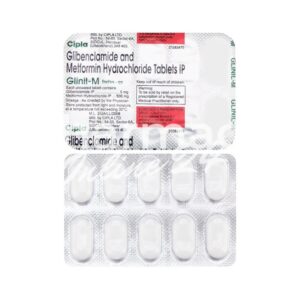
- Administration is oral — film‑coated tablets (biconvex, capsule‑shaped) taken with food.
- Glibenclamide begins to lower blood glucose within about 1–2 hours (peak effect ~2–4 hours); metformin’s biochemical effects start within hours but clinical improvement is often seen over days to weeks, so combined benefits may be noticed within a few days.
- Glibenclamide’s glucose‑lowering effect can persist up to about 24 hours; metformin provides sustained control with regular dosing, so once‑ or twice‑daily dosing maintains effect.
- Avoid excessive alcohol — alcohol increases the risk of metformin‑associated lactic acidosis and can potentiate hypoglycaemia from the glibenclamide component.
- The most common side effects are gastrointestinal symptoms such as nausea, diarrhoea and abdominal discomfort (from metformin); hypoglycaemia is also a common and important adverse effect due to glibenclamide.
- Would you like to try Glucovance without a prescription?
Basic Glucovance information
- INN (international nonproprietary name): Glibenclamide and metformin hydrochloride
- ATC code: A10BD02
- Forms and dosages: Tablets 2.5 mg glibenclamide / 500 mg metformin and 5 mg glibenclamide / 500 mg metformin
- OTC / Rx classification: Prescription-only medicine (POM)
What Glucovance contains and how it works
What are the active ingredients and why are they combined?
Glucovance is a fixed-dose combination of glibenclamide and metformin hydrochloride.
The International Nonproprietary Name is glibenclamide and metformin hydrochloride and the ATC code is A10BD02.
Glibenclamide belongs to sulfonylureas and stimulates pancreatic insulin release.
Metformin is a biguanide that reduces hepatic gluconeogenesis and improves peripheral glucose uptake.
The combination offers dual mechanisms: increased insulin secretion plus reduced hepatic glucose output.
Use of the two agents together targets patients with residual beta-cell function who also need improved insulin sensitivity.
Active ingredients and INN
INN: Glibenclamide and metformin hydrochloride.
ATC code: A10BD02.
Mechanisms of action — practical summary
Glibenclamide enhances pancreatic insulin release in response to blood glucose.
Metformin lowers hepatic glucose production and increases peripheral glucose uptake.
Combined effect reduces fasting and post-prandial glucose more effectively than either agent alone for suitable patients.
Dosage forms, strengths and identification
Which strengths are commonly seen and how do tablets look?
Common strengths are 2.5 mg glibenclamide / 500 mg metformin and 5 mg / 500 mg tablets.
Common presentations and tablet ID
Always check the tablet strength, manufacturer marks and packaging against the prescription.
When in doubt, confirm with the prescriber before substitution.
Indications and clinical place in therapy
When is a glibenclamide/metformin combination indicated?
It is indicated as an adjunct to diet and exercise for adults with type 2 diabetes inadequately controlled on monotherapy.
Combination therapy is considered when metformin or a sulfonylurea alone fails to reach HbA1c targets and the patient has endogenous insulin production.
UK clinicians also consider cardiovascular profile, weight effects and hypoglycaemia risk when selecting therapy.
Incretin-based agents and SGLT2 inhibitors are often preferred for cardiorenal benefits, so glibenclamide/metformin is chosen according to patient response or contraindications to alternatives.
Licensed indication
Licensed as adjunct to diet and exercise for adults with type 2 diabetes inadequately controlled on a single agent.
When to choose combination vs stepwise therapy
Choose combination therapy when rapid improvement is needed and the patient meets safety criteria for both drugs.
Consider stepwise addition of a second agent when concerns about hypoglycaemia or renal function exist, or where newer agents offer greater cardiorenal benefit.
Prescribing, starting doses and titration (practical)
How should clinicians start and titrate Glucovance safely?
Begin with one tablet of 2.5/500 mg or 5/500 mg once or twice daily with meals.
Increase doses in increments no greater than 2.5 mg/500 mg per day every two or more weeks.
The usual maximum total daily dose is 20 mg glibenclamide with 2000 mg metformin in divided doses.
Confirm renal function before initiation and prior to each up-titration.
Schedule follow-up glucose and HbA1c checks 6–12 weeks after a dose change to assess response.
- Start low: 2.5/500 mg once daily with a meal.
- Reassess after 2 weeks and increase by 2.5/500 mg per day if required.
- Do not exceed 20 mg glibenclamide / 2000 mg metformin total daily.
Initial regimens and dose increases
Use progressive, small increases to balance glycaemic benefit with hypoglycaemia risk.
Maintain dosing with meals to reduce both GI effects and risk of low blood glucose.
Monitoring during titration
Baseline eGFR is required prior to start and repeated periodically, more often in elderly patients.
Check HbA1c 6–12 weeks after dose changes and then according to routine diabetes reviews.
Contraindications and when to withhold
Which patients must not take glibenclamide/metformin?
Absolute contraindications include renal dysfunction with eGFR less than 30 mL/min/1.73m² and metabolic acidosis including diabetic ketoacidosis or lactic acidosis.
Known hypersensitivity to glibenclamide, metformin or other sulfonylureas is an absolute contraindication.
Acute conditions likely to alter renal function, such as severe infection, dehydration or shock, require withholding the medicine.
- Absolute contraindications:
- eGFR <30 mL/min/1.73m².
- Metabolic acidosis, diabetic ketoacidosis or lactic acidosis.
- Known hypersensitivity to the components.
Relative contraindications where specialist input is advised include elderly patients, heart failure, hepatic impairment and recent iodinated contrast studies.
Absolute contraindications (quick list)
Renal dysfunction (eGFR <30), metabolic acidosis, hypersensitivity, acute conditions affecting renal function.
Situations requiring specialist input
Borderline renal function (eGFR 30–45), recurrent hypoglycaemia or significant comorbidities should prompt discussion with a diabetes specialist or the prescriber.
Side effects, drug interactions and risk mitigation
What adverse effects should patients expect and how are risks reduced?
Common effects include gastrointestinal upset, hypoglycaemia, headache, dizziness and a metallic taste.
Serious but uncommon risks are lactic acidosis from metformin and severe hypoglycaemia from glibenclamide.
Review the patient’s full medication list for interactions before dispensing.
| Interaction | Action |
|---|---|
| Other hypoglycaemic agents | Check cumulative hypoglycaemia risk and advise dose changes or monitoring |
| Beta-blockers | Warn patient beta-blockers can mask hypoglycaemia symptoms; increase monitoring |
| Cationic drugs affecting renal clearance | Assess renal function and consider alternative therapies or dose adjustment |
| Recent or planned iodinated contrast | Advise temporary metformin cessation per local radiology guidance |
Mitigation includes counselling on hypoglycaemia recognition and treatment, routine renal monitoring and pausing metformin when indicated by imaging protocols.
Common adverse effects and management
Advise taking tablets with meals to reduce nausea and diarrhoea.
Provide a hypoglycaemia action plan and ensure patients carry fast-acting carbohydrate.
Key drug interactions to flag
Flag other glucose-lowering medicines, beta-blockers and drugs that impair renal clearance to prevent metformin accumulation.
Special populations: elderly, renal/hepatic impairment, pregnancy and children
How should dosing change for older patients or those with organ impairment?
Start elderly patients at the lowest dose and titrate slowly while checking renal function more frequently.
Renal impairment is a key safety consideration: the combination is contraindicated if eGFR is below 30 mL/min/1.73m².
For eGFR between 30 and 45 consider specialist advice or stopping the combination and using alternative regimens.
Hepatic impairment is a contraindication and use should be avoided.
In pregnancy and lactation, insulin is often preferred and sulfonylureas or metformin require specialist review.
Paediatric use is not recommended or approved.
Dosing and safety considerations in seniors
Check renal function before initiation and at least annually, or more frequently if unstable.
Use the lowest effective dose and educate carers where appropriate.
Pregnancy, lactation and paediatrics
Specialist input is required for pregnancy and breastfeeding, as insulin is frequently the preferred treatment in pregnancy.
There is no approved paediatric indication for glibenclamide/metformin combination tablets.
Storage and counselling points
Store at room temperature up to 25°C and protect from moisture and light.
Keep the tablets in the original, correctly labelled container.
Take the tablets with food and carry fast-acting carbohydrate in case of low blood glucose.
Seek emergency care for severe hypoglycaemia or suspected lactic acidosis.
Legal status and availability in the UK
Glucovance (glibenclamide/metformin) is a prescription-only medicine (POM) in the UK.
In our online pharmacy, Glucovance is available without a prescription, with discreet delivery to the United Kingdom in 9–21 days.
Alternatives and switching guidance
What are the main alternatives to glibenclamide/metformin and how to switch safely?
Alternatives include sitagliptin/metformin combinations such as Janumet and older combinations like rosiglitazone/metformin (Avandamet), though use of the latter is limited.
Choice depends on efficacy, hypoglycaemia risk, weight effects and cardiorenal benefit profile.
| Option | Pros | Cons |
|---|---|---|
| Glucovance (glibenclamide/metformin) | Two mechanisms in one tablet | Higher hypoglycaemia risk; metformin GI effects |
| Janumet (sitagliptin/metformin) | Lower hypoglycaemia risk; weight neutral | Different side-effect profile |
| Avandamet (rosiglitazone/metformin) | Effective glycaemic control | Less used due to safety concerns |
When switching, reassess HbA1c, hypoglycaemia history and renal/hepatic status and coordinate cross‑titration with the prescriber.
Key alternative combinations and when to select them
Select incretin-based or SGLT2 options for cardiorenal benefit when clinically indicated.
Reserve sulfonylurea combinations for patients who respond well.
Generic substitution considerations
Verify bioequivalence, tablet strength and patient counselling points remain consistent when substituting generics.
Patient follow-up, monitoring and pharmacist interventions
What routine monitoring does a patient on Glucovance need?
Baseline HbA1c and eGFR before initiation are required, with HbA1c re-checks per UK diabetes guidance and renal monitoring at least annually.
Increase monitoring frequency for elderly patients or those with unstable renal function.
Pharmacists can run medication reviews, check for interactions and reinforce hypoglycaemia management.
Escalate care to the GP or diabetes specialist for recurrent hypoglycaemia, eGFR approaching less than 30 or suspected lactic acidosis.
The monitoring timeline below is a practical prompt for routine follow-up.
- Monitoring timeline:
- Baseline: eGFR, HbA1c.
- 2–12 weeks: Review glucose response after dose change.
- 6 months: Routine diabetes review.
- Annual: eGFR and HbA1c if stable.
Routine monitoring schedule
Check eGFR at baseline and at least annually or more often for at-risk patients.
Measure HbA1c at intervals recommended by diabetes guidelines, typically every 3–6 months until stable.
When to escalate to specialist care
Refer to specialist services for recurrent or severe hypoglycaemia, rapidly declining renal function or intolerable side effects.
Delivery across the United Kingdom
| City | Region | Delivery time |
|---|---|---|
| London | Greater London | 9–21 days |
| Birmingham | West Midlands | 9–21 days |
| Manchester | Greater Manchester | 9–21 days |
| Glasgow | Scotland | 9–21 days |
| Leeds | West Yorkshire | 9–21 days |
| Liverpool | Merseyside | 9–21 days |
| Bristol | South West | 9–21 days |
| Sheffield | South Yorkshire | 9–21 days |
| Newcastle upon Tyne | Tyne and Wear | 9–21 days |
| Edinburgh | Scotland | 9–21 days |
| Cardiff | Wales | 9–21 days |
| Belfast | Northern Ireland | 9–21 days |
| Plymouth | South West | 9–21 days |
| Norwich | East of England | 9–21 days |
| Stoke-on-Trent | Staffordshire | 9–21 days |