Premarin
In brief
- In our pharmacy, you can buy Premarin without a prescription, with delivery in 9–21 days throughout the United Kingdom; discreet and anonymous packaging.
- Premarin (conjugated oestrogens) is used as hormone replacement therapy to relieve vasomotor and urogenital symptoms of the menopause, for prevention of post‑menopausal osteoporosis, for hypoestrogenism and sometimes as palliative therapy in certain cancers; it works by replacing or supplementing endogenous oestrogens and activating oestrogen receptors.
- The usual dose is 0.3–1.25 mg once daily, with 0.3 mg or 0.625 mg commonly used as starting doses and 0.625 mg often used for osteoporosis prevention; doses are individualised.
- Administered orally as tablets (commonly 0.3 mg, 0.625 mg and 1.25 mg).
- Relief of symptoms may begin within 1–2 weeks, with more noticeable benefit over 4–8 weeks.
- The effect is maintained by daily dosing (roughly 24‑hour coverage per dose); continuous therapy is usual and symptoms return after stopping the medicine.
- Avoid excessive alcohol; alcohol can worsen liver problems and may increase some risks and side effects associated with oestrogen therapy.
- The most common side effect is headache.
- Would you like to try Premarin without a prescription?
Basic Premarin information
- INN (international nonproprietary name): Conjugated oestrogens.
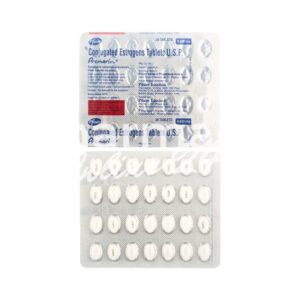
- Brand names available in the United Kingdom: Premarin (marketed by Pfizer; pack sizes and strengths for the UK include 0.3 mg, 0.625 mg and 1.25 mg tablets in boxes of 28)
- ATC code: G03CA57.
- Forms and dosages: tablets 0.3 mg, 0.625 mg and 1.25 mg.
- Manufacturers in the United Kingdom: Pfizer.
- Registration status in the United Kingdom: Registered; prescription-only medicine (POM).
- OTC / Rx classification: Prescription-only medicine (POM)
Legal status and availability in the UK
Premarin is a prescription-only medicine (POM) in the UK.
In our online pharmacy, Premarin is available without a prescription, with discreet delivery to the United Kingdom in 9–21 days.
Product identity, composition and classification
Active substance and pharmacological class
What is in Premarin and how is it classified?
The INN for Premarin is conjugated oestrogens, a mixture of natural oestrogens derived from equine sources.
The ATC code is G03CA57, classifying the product as oestrogens for systemic use, specifically conjugated natural oestrogens.
This classification determines formulary placement and regulatory categorisation within HRT options.
Formulation and marketed strengths
Which forms and strengths are sold?
Premarin is supplied as oral tablets in strengths of 0.3 mg, 0.625 mg and 1.25 mg.
Tablets are the main outpatient presentation and are usually packed in 28-tablet boxes in the UK market.
| Marketed strength | Form |
|---|---|
| 0.3 mg | Tablet |
| 0.625 mg | Tablet |
| 1.25 mg | Tablet |
Indications and targeted use cases
Licensed indications
What is Premarin licensed to treat?
Premarin is licensed for hormone replacement therapy to relieve vasomotor and urogenital menopausal symptoms.
It is also licensed for prevention of postmenopausal osteoporosis, for hypoestrogenism due to ovarian failure and for palliative treatment in certain cancer settings.
Prescribers should document the indication on prescriptions and supply the MHRA patient information leaflet with the medicine.
Practical selection guidance
How do clinicians choose the right dose?
Starting doses for menopausal symptoms are commonly 0.3 mg or 0.625 mg daily and should be adjusted to the lowest effective dose for symptom control.
For osteoporosis prevention, 0.625 mg daily is a commonly referenced dose when oestrogen therapy is considered appropriate.
- Licensed indications: menopausal vasomotor symptoms, urogenital atrophy, osteoporosis prevention, hypoestrogenism and palliative oncology use.
| Indication | Typical starting dose |
|---|---|
| Menopausal symptoms | 0.3–0.625 mg daily |
| Osteoporosis prevention | 0.625 mg daily |
| Hypoestrogenism | Individualised 0.3–1.25 mg daily |
Dosage regimens, administration and missed doses
Typical regimens and titration
What dosing schedules are used for Premarin?
Adults are commonly prescribed 0.3–1.25 mg daily depending on the indication and clinical response.
Menopausal symptom relief typically begins at 0.3 mg or 0.625 mg daily, titrating as necessary to symptom control at the lowest effective dose.
Both continuous and cyclic regimens are used; cyclic regimens such as three weeks on, one week off may be chosen for women with an intact uterus where a progestogen is also used.
Practical administration notes
How should patients take missed doses and what about overdoses?
Take the tablet orally at the same time each day to aid adherence.
If a dose is missed, take it as soon as remembered unless it is almost time for the next dose; do not take a double dose to make up.
In overdose patients may experience nausea, vomiting or withdrawal bleeding and should seek medical attention.
Packaging and strengths
UK packaging and presentation
What does Premarin look like in the UK dispensary?
In the UK Premarin is typically supplied in boxes of 28 tablets at strengths of 0.3 mg, 0.625 mg and 1.25 mg manufactured by Pfizer.
Each pack is supplied with the MHRA‑approved patient information leaflet.
Contraindications and warnings
Absolute contraindications
Who must not take Premarin?
Absolute contraindications include undiagnosed vaginal bleeding and known or suspected breast or uterine cancer.
Active or a history of deep vein thrombosis, pulmonary embolism, recent stroke or myocardial infarction are absolute contraindications.
Severe liver dysfunction, pregnancy and breastfeeding are also absolute contraindications to use.
Relative risks
When should the pharmacist or prescriber pause and check before supply?
Relative risks include uncontrolled hypertension, diabetes, obesity, smoking, prolonged immobilisation and hereditary angioedema, all of which raise thromboembolic risk.
Pharmacists should use a private consultation to verify medical history, document answers and liaise with prescribers where appropriate.
- Points to check before supply: current unexplained bleeding; history of breast or uterine cancer; prior VTE, PE, stroke or MI; severe liver disease; pregnancy or breastfeeding.
Side effects, surveillance and reporting
Common adverse effects and patient signals
What side effects should patients expect and report?
Common adverse effects can include headache, breast pain or tenderness, abdominal cramps, bloating, vaginal spotting, nausea and mood changes.
Many adverse effects are mild or transient, but symptoms suggestive of thrombosis or severe neurological events require urgent medical review.
Monitoring and pharmacovigilance
How should patients be monitored while on Premarin?
Baseline and periodic checks should include blood pressure, weight and adherence to breast screening and cervical screening as applicable.
Suspected adverse drug reactions must be reported to the Yellow Card Scheme in the UK to support pharmacovigilance.
- Red flag symptoms: sudden chest pain or breathlessness, sudden unilateral leg swelling, sudden severe headache or visual disturbance — seek urgent care.
| Symptom frequency | Likely action |
|---|---|
| Common (for example nausea, breast tenderness) | Monitor; review at routine follow‑up |
| New/unusual bleeding | Contact GP for investigation |
| Red flag thrombotic or stroke signs | Urgent A&E |
Drug interactions, hepatic and renal considerations
Key interactions to check
Which medicines affect Premarin and vice versa?
Medicines that induce hepatic enzymes, such as some anticonvulsants and rifampicin, can reduce oestrogen levels and reduce clinical effect.
Anticoagulant therapy may require monitoring adjustments when oestrogen therapy is started or stopped.
Interactions with thyroid replacement and systemic corticosteroids should be checked during medication reconciliation.
Organ impairment and dose adjustments
When is caution or avoidance needed?
Use with caution in renal impairment and consider dose adjustments for frail or elderly patients, who should receive the lowest effective dose.
Severe hepatic dysfunction is a contraindication to use and Premarin should be avoided in that setting.
Switching, comparators and alternatives
When to switch from Premarin
Why might a prescriber or patient choose to switch?
Switching can be due to side effects, patient preference, formulary availability or pursuit of lower‑risk delivery routes.
Document equivalence carefully when moving between conjugated oestrogens and estradiol products and ensure clinical oversight during transition.
Competitors and therapeutic alternatives
What are common alternatives to Premarin?
Alternatives include estriol preparations such as Ovestin and various estradiol products, including gels and transdermal patches.
Transdermal oestrogen routes are often favoured where reducing venous thromboembolism risk is a priority.
| Product | Route | Notes |
|---|---|---|
| Premarin (conjugated oestrogens) | Oral | Systemic oestrogen; licensed for menopause and osteoporosis prevention |
| Estradiol | Oral or transdermal | Common alternative; transdermal route linked with lower VTE risk |
| Ovestin (Estriol) | Topical (vaginal) | Targeted for urogenital atrophy |
- Switching steps: review the indication and any history of VTE or cancer, choose an equivalent dose and arrange follow-up 4–12 weeks after the change.
Storage and handling
Storage
How should Premarin be stored?
Store Premarin tablets at room temperature between 15–30°C and protect from moisture and light.
Keep in the original packaging until use to retain the patient information leaflet and batch number for reference.
Travel
Patients travelling with Premarin should carry the original packaging and a copy of their prescription.
Counselling points and patient leaflets
Key counselling points at supply
What should be covered when handing over Premarin?
Explain the indication, expected onset of benefit and the prescribed dose and regimen.
Cover common side effects and emphasise red flags such as chest pain, sudden breathlessness or unilateral leg swelling.
Reinforce the importance of routine breast screening, smoking cessation and contraception if relevant for the patient.
Documentation and follow‑up
How should supply be documented and when should patients be reviewed?
Read the MHRA patient information leaflet supplied with the medicine, which includes Yellow Card reporting details.
Offer a medication review or follow-up contact within 4–12 weeks to assess tolerance and adherence.
- Counselling summary: indication, dose, missed‑dose instructions, common side effects, red flags, follow-up interval and Yellow Card reporting advice.
Delivery across the United Kingdom
| City | Region | Delivery Time |
|---|---|---|
| London | England | 9–21 days |
| Birmingham | England | 9–21 days |
| Manchester | England | 9–21 days |
| Leeds | England | 9–21 days |
| Glasgow | Scotland | 9–21 days |
| Edinburgh | Scotland | 9–21 days |
| Liverpool | England | 9–21 days |
| Bristol | England | 9–21 days |
| Cardiff | Wales | 9–21 days |
| Belfast | Northern Ireland | 9–21 days |
| Newcastle | England | 9–21 days |
| Sheffield | England | 9–21 days |
| Norwich | England | 9–21 days |
| Portsmouth | England | 9–21 days |