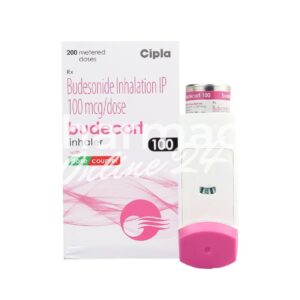
Budecort
In stock
100mcg
from 51,33 £
In brief
- In our pharmacy you can buy Budecort without a prescription, with delivery across the United Kingdom in 9–21 days and discreet packaging.
- Budecort (budesonide) is used for maintenance treatment of asthma, as part of COPD combination therapy, for allergic rhinitis and for local treatment of inflammatory bowel disease; it is a corticosteroid that binds glucocorticoid receptors to reduce airway, nasal and gastrointestinal inflammation.
- The usual dose depends on the formulation: inhaled 200–800 μg/day (commonly 100–400 μg per dose), nebules 0.25–1 mg per 2 ml, oral Entocort 9 mg once daily for Crohn’s disease, rectal foam 2 mg once or twice daily and nasal spray 64 μg per nostril.
- The form of administration is inhaler (pMDI or dry powder), nebuliser/respule, enteric‑coated oral capsule, rectal foam/enema or nasal spray.
- Onset time: nasal sprays can begin to relieve symptoms within hours; inhaled anti‑inflammatory effects usually start to appear over days with meaningful improvement in 1–2 weeks; full benefit may take several weeks.
- Duration of action: effects are maintained with regular daily dosing (usually once or twice daily depending on formulation); systemic elimination half‑life is short (~2–3.5 hours) but local therapeutic effect lasts longer.
- Alcohol warning: no specific acute interaction with moderate alcohol is expected, but avoid excessive alcohol and use caution if you have liver impairment because budesonide is primarily metabolised hepatically.
- The most common side effect is oral candidiasis (“thrush”) with inhaled use; other common effects include hoarseness, throat or nasal irritation and, with systemic exposure, headache or nausea.
- Would you like to try Budecort without a prescription?
Basic Budecort information
- INN (international nonproprietary name): Budesonide
- Brand names available in the United Kingdom: Pulmicort, Entocort, Budenofalk, Rhinocort; generic budesonide inhalers and nasal sprays. Budecort (Cipla) itself is not a UK-licensed brand.
- ATC code: R03BA02 (inhaled respiratory use) and A07EA06 (gastrointestinal formulations)
- Forms and dosages: inhaler 100 μg / 200 μg / 400 μg per dose; nebules/respules 0.25 mg, 0.5 mg, 1 mg per 2 ml; capsules 3 mg (Entocort); rectal foam 2 mg (Budenofalk); nasal spray 32 μg per actuation
- Manufacturers in the United Kingdom: AstraZeneca (Pulmicort), Tillotts Pharma (Entocort), Dr Falk Pharma (Budenofalk) and generic manufacturers
- Registration status in the United Kingdom: Several budesonide products are licensed by the MHRA and are prescription-only; Budecort itself is not a UK-licensed brand
- OTC / Rx classification: Most budesonide products are prescription-only medicines (POM) in the UK
Legal status and availability in the UK
Budesonide products are prescription-only medicines (POM) in the UK.
In our online pharmacy, Budecort is available without a prescription, with discreet delivery to the United Kingdom in 9–21 days.
What Budecort is — drug identity and classification
Which active substance is in Budecort and how is it classified?
Budecort contains the active substance budesonide, the International Nonproprietary Name (INN) budesonide.
The ATC classification places inhaled budesonide under R03BA02 for corticosteroids for local respiratory use, and gastrointestinal formulations are classified under A07EA06.
Budesonide is a topical corticosteroid with high first-pass hepatic metabolism, which helps to limit systemic exposure when used locally.
That local action explains why inhaled, nasal and enteric forms produce strong local benefit with relatively low systemic steroid effects.
Prescribers choose between brands and formulations—Budecort, Pulmicort, Entocort or Budenofalk—based on device, dose and clinical indication.
Budesonide-containing products are prescription-only medicines in the UK.
Active substance, INN and ATC class
- INN: Budesonide.
- ATC: R03BA02 (inhaled respiratory); A07EA06 (gastrointestinal enteric products).
- Mechanism of action: Topical corticosteroid that reduces airway and mucosal inflammation locally; extensive first-pass hepatic metabolism reduces systemic exposure.
Available formulations and packaging for Budecort and equivalents
Which forms does budesonide come in and how are they packaged?
Budesonide is marketed across multiple dosage forms: pressurised inhalers, dry powder devices, nebules/respules for nebulisation, enteric-coated capsules, rectal foam/enemas and nasal sprays.
Typical inhaler strengths include 100 μg and 200 μg per dose, with some devices offering 400 μg doses for higher needs.
Nebules are commonly supplied as 0.25–1 mg in 2 ml ampoules for use with a compressor nebuliser.
Entocort capsules are typically 3 mg and used for Crohn’s disease as enteric-coated capsules, and rectal foam products are normally around 2 mg for distal colitis or proctitis.
Packaging mirrors the dosage form: respules in small ampoules, capsules in blister packs and inhalers with canisters and mouthpieces.
Inhalers, nebules, capsules, foams and sprays
| Form | Typical dosage | Common indication |
|---|---|---|
| Pressurised inhaler | 100 μg, 200 μg, 400 μg / dose | Asthma maintenance |
| Dry powder inhaler (Turbuhaler) | 100 μg, 200 μg per dose | Asthma maintenance |
| Nebules/respules | 0.25 mg, 0.5 mg, 1 mg / 2 ml | Children/adults with severe asthma or nebuliser requirement |
| Enteric-coated capsules (Entocort) | 3 mg; induction 9 mg once daily (Crohn’s) | Crohn’s disease, microscopic colitis |
| Rectal foam/enema | 2 mg foam | Ulcerative colitis, proctitis |
| Nasal spray | 32 μg/actuation (typical) | Allergic rhinitis |
Indications, typical regimens and practical duration guidance
What conditions is budesonide used for and how long is it usually given?
Budesonide is indicated for maintenance treatment of asthma when inhaled, as part of some COPD regimens, for allergic rhinitis with nasal sprays, and for local gastrointestinal conditions using enteric or rectal formulations.
Adult inhaled maintenance doses commonly range from 200–800 μg per day divided into two doses depending on severity and device.
Nebule dosing typically ranges 0.25–1 mg per ampoule depending on age and severity and is administered via a compatible compressor nebuliser.
Entocort capsules are commonly used at 9 mg once daily for Crohn’s disease induction, usually for around eight weeks before reassessment.
Nasal dosing is commonly 64 μg per nostril once or twice daily depending on product instructions and symptom control.
Duration is chronic for asthma and COPD maintenance, seasonal or ongoing for rhinitis, and 8–12 weeks for many GI induction regimens.
Respiratory, GI and ENT use cases
- Asthma: maintenance therapy, not emergency relief.
- Crohn’s disease: enteric capsules for induction, typically 8 weeks at higher dose.
- Allergic rhinitis: nasal sprays during symptomatic periods.
How to use each dosage form — stepwise practical guidance
How should patients be shown to use their particular budesonide device?
Correct technique is essential to get the full benefit and reduce side effects such as oral thrush.
Pressurised inhaler (e.g., Budecort inhaler): shake the device, breathe out fully, seal lips around the mouthpiece, actuate as you begin a slow deep breath, hold for 5–10 seconds, then rinse mouth.
Dry powder inhaler (Turbuhaler/Pulmicort): load the dose per device instructions, exhale away from the mouthpiece, inhale forcefully and deeply, hold briefly and rinse mouth.
Nebules/respules: open ampoule aseptically, connect to compatible nebuliser, administer until solution is gone (typically 5–10 minutes) and follow device cleaning instructions.
Entocort capsules: swallow whole with water; do not chew or crush because of the enteric coating designed to release in the intestine.
Rectal foam: lie on left side or kneel-over-chest position as shown on leaflet, insert applicator gently and actuate; remain lying for a few minutes.
Nasal spray: shake gently if required, tilt head slightly forward, insert nozzle and sniff gently while actuating, avoid spraying directly onto the septum.
Inhaler, nebule/respule, capsule, foam, nasal spray
Device technique should be checked at dispensing, with an inhaler technique review offered if control is poor.
Efficacy and clinical data summary (practical interpretation)
How quickly and how well does budesonide work in real life compared with trial data?
Randomised trials and real-world studies show inhaled budesonide reduces asthma exacerbations and improves lung function at low-to-moderate doses.
Patients often notice symptomatic improvement within days for rhinitis and within a few weeks for better asthma control.
Enteric budesonide provides local benefit in mild-to-moderate Crohn’s disease, particularly for ileocaecal disease, and is associated with fewer systemic steroid effects for limited disease distribution.
Comparative data suggest fluticasone may have longer airway retention while budesonide is cleared faster systemically, which reduces systemic exposure.
Real-world effectiveness
- Budesonide reduces exacerbation frequency and improves peak flow and symptom scores in trials.
- Enteric budesonide is effective for induction in selected Crohn’s patients but treatment is usually limited to 8–12 weeks.
- Expect symptom improvement in days to weeks depending on the indication.
Safety profile, common adverse effects and monitoring
What side effects should patients expect and how should they be monitored?
Common local effects of inhaled budesonide include oral candidiasis (thrush), hoarseness, cough and throat irritation.
Nasal formulations may cause nasal irritation, mild epistaxis or sore throat in some users.
Systemic adverse effects are rare with inhaled/topical forms due to significant first-pass hepatic metabolism, but long-term high doses can increase risk of hypothalamic–pituitary–adrenal axis suppression and growth effects in children.
Advise routine mouth rinsing after inhaler use and spacer use where appropriate to reduce oropharyngeal deposition and thrush risk.
Monitor children’s growth during prolonged therapy and consider bone health assessment in older adults on long-term high-dose therapy.
Report suspected adverse drug reactions using the MHRA Yellow Card scheme.
Local vs systemic effects, prevention and follow-up
- Common: oral thrush, hoarseness, throat irritation — prevent by rinsing mouth and using spacer.
- Less common/serious: adrenal suppression with chronic high systemic exposure; monitor and refer as needed.
- Follow-up: inhaler technique review, growth checks in children and bone risk assessment in frail older adults.
Contraindications, relative cautions and red flags
When must budesonide not be used, and when should prescribers be alerted?
Absolute contraindications are known hypersensitivity to budesonide or any excipient and using inhaled budesonide as sole therapy in severe acute asthma attacks.
Relative cautions include active untreated infections such as tuberculosis or fungal respiratory infections, significant hepatic impairment and conditions increasing risk from corticosteroids like osteoporosis, glaucoma or cataracts.
Red flags requiring urgent review include signs of adrenal crisis (severe fatigue, persistent vomiting), new severe infection, sudden visual changes or severe psychiatric symptoms.
For rectal or enteric products, take extra care when systemic immunosuppression is present and consult the prescribing specialist for complex cases.
Absolute contraindications and when to refer
| Contraindication | Action |
|---|---|
| Hypersensitivity to budesonide/excipients | Do not use; contact the prescriber |
| Severe acute asthma as sole therapy | Do not use; urgent medical treatment required |
| Active untreated TB or fungal infection | Defer and refer; treat the infection first |
Drug interactions and hepatic considerations
Which medicines change budesonide levels and what checks are needed?
Budesonide is metabolised predominantly by CYP3A4, so potent CYP3A4 inhibitors such as ketoconazole or itraconazole can increase systemic budesonide exposure.
Long-term use of potent inhibitors increases the risk of systemic corticosteroid effects even with inhaled or nasal preparations.
Combining budesonide with other systemic corticosteroids increases risk of adrenal suppression, so review the full medication list before supply.
Patients with significant hepatic impairment have reduced budesonide clearance and may need closer monitoring or dose review by the prescriber.
Key enzymatic interactions and practical checks
| Drug | Effect on budesonide | Action |
|---|---|---|
| Ketoconazole / Itraconazole | Increase systemic budesonide levels | Alert prescriber; consider dose review |
| Protease inhibitors | May increase systemic exposure | Discuss with prescriber for long-term use |
| Systemic corticosteroids | Additive systemic effects | Monitor for adrenal suppression |
Dosage adjustments for children, elderly and special populations
How are doses adapted for children, older people and those with liver disease or pregnancy?
Children usually start at lower inhaled doses — commonly 100–400 μg/day depending on age and severity — and nebules or respules are often preferred for very young children.
Growth should be recorded at baseline and monitored over prolonged treatment in paediatric patients.
In the elderly there is no routine dose reduction, but start at the lowest effective dose because of higher risks from systemic steroid effects such as osteoporosis and glaucoma.
Use caution in hepatic impairment due to reduced metabolism; consider specialist advice for dose changes or alternative therapy.
For pregnancy and breastfeeding, inhaled budesonide is considered one of the preferred inhaled corticosteroids owing to available safety data, but specialists should be consulted for systemic therapy decisions.
Practical dosing ranges and monitoring priorities
- Paediatric: 100–400 μg/day inhaled depending on age/severity; monitor growth.
- Elderly: start low and monitor bone health, eyes and glucose where relevant.
- Liver impairment: use with caution and liaise with prescriber for dose review.
Storage and handling
How should budesonide products be stored?
Store most budesonide products at room temperature, typically 15–30°C, and avoid freezing nebules or respules.
Protect aerosols, sprays and inhalers from direct sunlight and high temperatures and keep them capped when not in use to prevent moisture entry.
Check the device expiry date after opening, as stated in the manufacturer leaflet.
Practical storage instructions
- Store at 15–30°C; do not freeze nebules/respules.
- Keep inhalers and sprays away from heat and sunlight; replace if exposed to extremes.
Practical counselling, troubleshooting and follow-up advice
What should patients be told about budesonide?
Emphasise that budesonide is maintenance therapy and not a rescue inhaler; show the inhaler or device and check technique before the patient leaves.
Advise rinsing the mouth after inhalation and using a spacer to reduce thrush risk if appropriate.
Troubleshoot common problems: poor control often stems from adherence, incorrect technique, use of an expired device, or drug interactions with CYP3A4 inhibitors.
If a patient is using reliever inhalers frequently or has recent exacerbations, escalate to the GP or specialist for possible dose adjustment or therapy change.
Missed dose advice: take as soon as remembered unless near the next dose; do not double up.
Provide a written asthma action plan where relevant and arrange an inhaler technique review within a few weeks of starting therapy.
Common problems and what to do
- Poor control: check adherence and device technique; offer spacer and training.
- Thrush or hoarseness: advise mouth rinsing, consider spacer or review dose.
- Possible interaction: review medication list for CYP3A4 inhibitors and notify prescriber if needed.
Delivery across the United Kingdom
| City | Region | Delivery Time |
|---|---|---|
| London | Greater London | 9–21 days |
| Birmingham | West Midlands | 9–21 days |
| Manchester | Greater Manchester | 9–21 days |
| Glasgow | Scotland | 9–21 days |
| Edinburgh | Scotland | 9–21 days |
| Cardiff | Wales | 9–21 days |
| Belfast | Northern Ireland | 9–21 days |
| Liverpool | Merseyside | 9–21 days |
| Bristol | South West England | 9–21 days |
| Leeds | West Yorkshire | 9–21 days |
| Sheffield | South Yorkshire | 9–21 days |
| Newcastle | Tyne and Wear | 9–21 days |
| Plymouth | Devon | 9–21 days |
| Norwich | East of England | 9–21 days |