Cilostazol
In brief
- In our pharmacy, you can buy cilostazol without a prescription, with delivery in 5–14 days throughout the United Kingdom. Discreet and anonymous packaging.
- Cilostazol is used to relieve walking discomfort from intermittent claudication in peripheral arterial disease; it is a phosphodiesterase III inhibitor that raises cAMP in platelets and blood vessels, producing antiplatelet and vasodilator effects.
- The usual dose is 100 mg taken orally twice daily (adult dose), typically at least 30 minutes before breakfast and dinner.
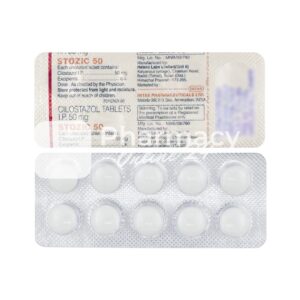
- Administration is by oral film‑coated tablet (commonly 50 mg or 100 mg; supplied in blisters or bottles).
- The onset of effect is gradual — some patients notice improvement within weeks, but full benefit may take up to 12 weeks.
- Duration of treatment is generally long‑term until symptoms improve, with periodic review; discontinue if no benefit after about 3 months.
- Avoid alcohol or limit intake while taking cilostazol, as alcohol may worsen dizziness, palpitations or other side effects.
- The most common side effect is headache.
- Would you like to try cilostazol without a prescription?
Basic Cilostazol Information
- INN (International Nonproprietary Name): Cilostazol (INN worldwide; also written as シロスタゾール in Japanese sources).
- Brand Names Available In United Kingdom: Pletal, Cilostazol — 100 mg tablets supplied in blister packs of 56 or 112 tablets.
- ATC Code: B01AC23.
- Forms & Dosages: Film-coated tablets 100 mg and 50 mg are available; typical blister pack sizes include 10, 14, 30, 56, 60 and 100 tablets.
- Manufacturers In United Kingdom: Otsuka Pharmaceutical, Accord Healthcare, Mylan, Bluefish, EG Labo.
- Registration Status In United Kingdom: MHRA-authorised prescription medicine.
- OTC / Rx Classification: Prescription only (Rx) in the United Kingdom.
Market Realities & Patient Experiences
Availability And Real-World Access
Patients in the United Kingdom will usually encounter cilostazol as prescription-only medicine, supplied under brand names such as Pletal or as generics.
Major retail and hospital pharmacies and NHS prescribing routes typically handle supply in blister packs of 56 or 112 tablets as recorded for the UK market.
Regional NHS prescribing practice varies and local formularies may influence whether cilostazol is selected after supervised exercise and other measures have been tried.
Private clinics and private prescriptions are another route for patients who prefer to pay per pack or receive vascular clinic management for peripheral arterial disease.
Pharmacists report intermittent peaks in demand linked to clinic referrals and occasional supply constraints when particular generics are in short supply.
Distribution channels include community pharmacies, hospital dispensaries, private clinics and e-prescription fulfilment by registered online pharmacies.
- NHS Pathway: Referral → Assessment → Supervised exercise first → Prescribe if needed.
- Private Pathway: GP/private clinic → Private prescription → Dispense by retail or online pharmacy.
Patient-Reported Benefits & Tolerability
Typical Experiences From Users
Many patients report gradual improvement in walking distance and reduction in leg discomfort within weeks of starting cilostazol.
Clinical and community feedback commonly notes clearer benefit by around eight to twelve weeks of therapy.
Common side effects that most affect adherence are headache, palpitations and diarrhoea, and some patients stop for persistent tachycardia or severe headaches.
Practical counselling usually emphasises taking doses at least 30 minutes before breakfast and dinner to reduce gastrointestinal upset.
Quality-of-life gains described by patients include resuming short neighbourhood walks and performing daily tasks with less pain.
Pharmacists should set realistic expectations and advise discontinuation if no symptomatic improvement after about three months.
- Patient Testimonial: “After six weeks I could walk to the shop without stopping every few metres.”
- Patient Testimonial: “Headaches were the worst part at first, but they eased after a fortnight.”
- Tolerability Checklist: Watch for headache, palpitations, diarrhoea, dizziness and gastrointestinal upset; advise reporting troublesome symptoms.
Product Basics, Branding & Packaging
Global And UK Presentation
Cilostazol is supplied primarily as film-coated tablets, most commonly in a 100 mg strength and less frequently as 50 mg tablets.
Packaging formats include blister packs and, in some markets, bottles; the UK market commonly lists 56- and 112-tablet blisters for chronic dosing.
Brand names vary between markets; the UK lists Pletal and generics labelled simply as Cilostazol.
| Brand | Strength | Typical Pack Sizes |
|---|---|---|
| Pletal | 100 mg | 56, 112 tablets (blister) |
| Cilostazol (generic) | 100 mg, 50 mg | 10, 14, 30, 56, 60, 100 (blisters) |
| Cilostazol Accord | 100 mg | 60 tablets (box) |
Indications & Who It’s For
Primary Licensed Use And Clinical Context
The licensed indication is symptomatic treatment of intermittent claudication due to peripheral arterial disease to improve walking distance and reduce discomfort.
Cilostazol is not indicated for acute ischaemic events, stroke prevention or as a routine substitute for antiplatelet therapy used for cardiac indications.
In primary care and vascular clinics it is considered when supervised exercise and smoking cessation have not provided sufficient symptom control.
NHS formularies typically require documented peripheral arterial disease symptoms and a baseline cardiovascular review before commencing treatment.
- Indication: Symptomatic intermittent claudication due to peripheral arterial disease.
- Contraindication: Any grade of congestive heart failure, moderate/severe hepatic impairment, severe renal impairment and active pathological bleeding.
- Treatment Goals: Increase pain-free and maximum walking distance and improve daily function.
Mechanism Of Action & Pharmacology
How Cilostazol Works And Onset
Cilostazol is a phosphodiesterase III inhibitor that raises intracellular cyclic AMP in platelets and vascular smooth muscle cells.
The rise in cAMP produces antiplatelet effects and vasodilation, which together help increase walking distance in intermittent claudication.
Onset of symptomatic improvement is gradual, with many patients noticing change over several weeks and full effect often assessed by 12 weeks.
- Pharmacokinetic Notes: Metabolised primarily via hepatic CYP pathways; steady-state exposure achieved after several days of dosing.
- Hepatic Consideration: Hepatic impairment can cause accumulation and is a contraindication in moderate to severe liver disease.
Dosage, Administration & Missed Dose
Standard Regimen And Practical Tips
The standard adult dose for intermittent claudication is 100 mg taken orally twice daily.
Doses should be taken at least 30 minutes before breakfast and at least 30 minutes before the evening meal to optimise absorption and reduce gastrointestinal side effects.
Linking each dose to established morning and evening routines helps adherence.
Only film-coated tablets are commonly marketed; there are no parenteral or topical forms available for cilostazol.
- Administration Checklist: Take 100 mg twice daily, at least 30 minutes before meals; do not crush film-coated tablets; store in original packaging.
| Missed Dose | Overdose |
|---|---|
| Take as soon as remembered unless the next dose is due soon; do not double the dose. | Seek immediate medical attention; expected acute effects include tachycardia, hypotension and arrhythmias. |
Special Populations & Dose Adjustments
Elderly, Hepatic, Renal And Paediatric Notes
Children: Safety and efficacy have not been established and use is not recommended.
Elderly patients generally require no initial dose change but clinicians should consider comorbidities, polypharmacy and increased sensitivity to adverse effects such as tachycardia or dizziness.
Hepatic impairment: Cilostazol is contraindicated in moderate to severe hepatic impairment because of risk of accumulation and toxicity.
Renal impairment: Mild to moderate renal dysfunction may be treated with caution, while severe renal impairment is generally not recommended.
- Practical Rule: Flag liver disease, significant renal impairment and age-related vulnerabilities on the dispensing record and refer to prescriber where necessary.
Contraindications & Cautions
Absolute Vs Relative Contraindications
| Absolute Contraindications | Relative Cautions |
|---|---|
| Congestive heart failure (any grade); known hypersensitivity to cilostazol or excipients; severe hepatic impairment; severe renal impairment; active pathological bleeding; pregnancy. | History of arrhythmias or ischaemic heart disease; uncontrolled hypertension; bleeding disorders; concomitant use of multiple antiplatelet or anticoagulant agents. |
Documented cardiac disease often requires cardiology input prior to initiation because of cilostazol’s cardiovascular effects.
Side Effects, Monitoring & When To Stop
Common Adverse Effects And Serious Signals
Common side effects are usually mild to moderate and include headache, diarrhoea, palpitations, dizziness, peripheral oedema, abdominal pain and nausea.
More serious but less frequent events include arrhythmias and clinically significant bleeding complications.
Baseline assessment of heart rate and blood pressure is advisable, with early monitoring during the first weeks of treatment.
- Monitoring Checklist: Check baseline cardiovascular history, record resting heart rate and blood pressure, review concomitant bleeding risk and follow up within 2–4 weeks where possible.
| Stop / Refer Red Flags | Action |
|---|---|
| New or worsening palpitations, syncope, chest pain, severe persistent headache, signs of bleeding (e.g., unexpected bruising, melaena). | Discontinue cilostazol and refer urgently to the prescriber or emergency services as appropriate. |
Review treatment after approximately three months and discontinue if there is no clear symptomatic benefit.
Drug Interactions & Metabolism
Key Interacting Medicines And Management
Cilostazol is metabolised mainly by hepatic CYP enzymes, notably CYP3A4 and CYP2C19, so drugs that strongly inhibit these enzymes can raise cilostazol levels.
Strong CYP3A4 inhibitors such as certain azole antifungals and macrolide antibiotics can increase exposure and risk of adverse effects and should prompt dose review or avoidance.
Concomitant antiplatelets or anticoagulants (for example aspirin, clopidogrel, warfarin and direct oral anticoagulants) increase bleeding risk and require close monitoring and documented counselling.
| Drug | Interaction | Action |
|---|---|---|
| Ketoconazole, clarithromycin | Strong CYP3A4 inhibition leading to higher cilostazol levels | Consider avoidance or specialist advice; monitor for adverse effects. |
| Cimetidine | May elevate cilostazol exposure | Use caution and monitor. |
| Clopidogrel, aspirin, warfarin, DOACs | Combined antiplatelet/anticoagulant effect increases bleeding risk | Document counselling, monitor bleeding signs and coordinate with prescriber. |
Pharmacists should always check the patient’s medication record for interactions and seek specialist input for complex polypharmacy.
Clinical Effectiveness & Evidence Summary
What Trials And Guidelines Say
Randomised trials and guideline summaries support a modest but clinically relevant benefit for cilostazol in improving pain-free and maximum walking distance compared with placebo in intermittent claudication.
Benefits accrue over weeks to months and full effect is commonly assessed at around twelve weeks, with discontinuation advised for non-responders.
Clinical guidance typically recommends supervised exercise programmes and risk factor modification first, with cilostazol considered for patients who remain symptomatic.
- Guideline Summary: Supervised exercise → Lifestyle/risk management → Cilostazol for persistent symptoms, with reassessment at ~12 weeks.
Comparisons, Competitors & Positioning
When Cilostazol Is Chosen Over Alternatives
Alternatives used in the management of peripheral arterial disease include clopidogrel, dipyridamole and pentoxifylline alongside non-pharmacological measures.
Cilostazol’s combined phosphodiesterase III inhibition provides both antiplatelet and vasodilatory effects, which is the mechanistic reason it is chosen for symptomatic improvement in claudication.
Pentoxifylline is sometimes used where cilostazol is contraindicated or not tolerated, while clopidogrel is principally selected for atherosclerotic event prevention rather than symptom relief for claudication.
| Drug | Mechanism | Use In PAD | Pros & Cons |
|---|---|---|---|
| Cilostazol | PDE‑III inhibitor (antiplatelet + vasodilator) | Symptomatic relief of intermittent claudication | Improves walking distance; contraindicated in heart failure. |
| Clopidogrel | ADP receptor blocker (antiplatelet) | Prevention of atherosclerotic events | Good for thrombosis prevention; lacks vasodilatory effect for claudication. |
| Pentoxifylline | Hemorheologic agent | Alternative for claudication symptoms | Less effective than cilostazol in some studies for walking distance. |
Buying, Prescribing & Legal Status In The UK
MHRA, NHS Prescribing And Pharmacy Practice
Cilostazol is a prescription-only medicine in the United Kingdom and is MHRA authorised.
Prescribers must document the indication and screen for contraindications such as heart failure and hepatic impairment before initiating therapy.
Local NHS formularies and commissioning policies may influence prescribing choices and whether cilostazol is recommended after supervised exercise.
Electronic prescriptions and registered online pharmacies with e-prescription fulfilment have increased patient access.
Retail chains and independent pharmacies frequently dispense 56- or 112-tablet packs and private prescription pricing varies by provider.
Pharmacists should verify prescriptions, counsel on dosing and side effects and refer to prescribers for any required dose or therapy changes.
In our online pharmacy, cilostazol is available without a prescription, with discreet delivery to United Kingdom in 5-14 days.
Pharmacy Counselling Checklist & Red Flags
Practical Counselling Points For Dispensing Staff
Give clear dosing instructions: take 100 mg twice daily at least 30 minutes before breakfast and dinner.
Explain that improvements are gradual and often assessed by about three months, and that treatment should be stopped if there is no benefit.
Highlight common side effects such as headache, palpitations and diarrhoea and advise patients to report severe or persistent symptoms.
Check medical history for heart failure, liver disease or significant renal impairment and review current medicines for CYP3A4 inhibitors or combined antiplatelet/anticoagulant therapy.
- Follow-Up: Document counselling and consider a follow-up call after 2–4 weeks to assess tolerance and adherence.
Provide a printable patient card summarising dose, timing, common side effects and when to stop and seek medical attention.
Storage, Transport, Disposal & Pack Sizes
Practical Handling And Dispensing Notes
Store cilostazol below 25°C, protect from moisture and light and keep in the original packaging until use.
Typical UK pack sizes for 100 mg tablets are blister packs of 56 or 112 tablets, with other countries listing 60 or 100 count options.
Advise patients travelling with medication to carry original packaging and prescribing documentation, especially when crossing international borders.
- Disposal: Return unused tablets to a pharmacy take-back scheme for safe disposal; do not flush medicines down the toilet.
| Country / Market | Common Pack Sizes |
|---|---|
| United Kingdom | 56, 112 tablets (blister) |
| Germany | 60, 100 tablets (box/blister) |
| Australia | 56 tablets (bottle) |
FAQs, SEO Hooks & Structured Data Suggestions
Suggested On-Page Elements And LSI Keywords
What Does Cilostazol Treat?
Cilostazol is used for symptomatic intermittent claudication to improve walking distance in peripheral arterial disease.
How Long Until It Works?
Benefit is gradual and commonly assessed around eight to twelve weeks; discontinue if no improvement after about three months.
Can I Take It With Aspirin?
Concomitant use with antiplatelets increases bleeding risk, so careful monitoring and documented counselling are needed.
Why Is It Contraindicated In Heart Failure?
Cilostazol’s cardiovascular actions mean any grade of congestive heart failure is an absolute contraindication due to increased risk.
Example Meta Description: “Cilostazol (Pletal) 100 mg — prescription treatment for intermittent claudication. MHRA-authorised; advice on dosing, side effects and interactions.”
Structured Data Placeholder: Medication schema (name: Cilostazol; dosage form: Film-coated tablet; rxOnly: true; manufacturer: Otsuka/Accord/Mylan; ATC: B01AC23).
Delivery Across United Kingdom
| City | Region | Delivery Time |
|---|---|---|
| London | Greater London | 5-7 days |
| Birmingham | West Midlands | 5-7 days |
| Manchester | Greater Manchester | 5-7 days |
| Glasgow | Scotland | 5-7 days |
| Leeds | West Yorkshire | 5-7 days |
| Liverpool | Merseyside | 5-7 days |
| Bristol | South West England | 5-7 days |
| Sheffield | South Yorkshire | 5-7 days |
| Edinburgh | Scotland | 5-7 days |
| Newcastle | North East England | 5-7 days |
| Nottingham | Nottinghamshire | 5-7 days |
| Leicester | Leicestershire | 5-7 days |
| Cardiff | Wales | 5-9 days |
| Belfast | Northern Ireland | 5-9 days |
| Plymouth | Devon | 5-9 days |