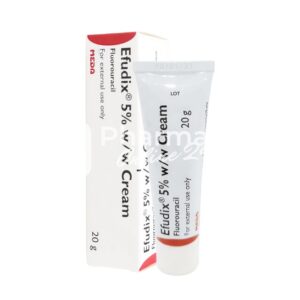
Efudix
In brief
- Efudix is a prescription-only medicine in many countries, including the UK and Europe, and is normally supplied via a pharmacy or authorised healthcare provider. However, availability can vary by country and some online pharmacies may offer it without a prescription where local rules permit.
- Efudix (fluorouracil) is used to treat actinic keratosis and selected superficial basal cell carcinomas. It is a topical antimetabolite chemotherapy medicine that blocks thymidylate synthase, inhibiting DNA synthesis in abnormal skin cells.
- The usual dose is a thin film applied twice daily, morning and evening, depending on the condition and the area being treated.
- It is supplied as a topical cream, typically 5%, and also as a topical solution in some markets.
- It usually begins to work over several days, with redness, irritation, and local inflammation often developing within the first 1–2 weeks of treatment.
- Duration of action is tied to the treatment course rather than a short single-dose effect: actinic keratosis is usually treated for 2–4 weeks, and superficial basal cell carcinoma for 3–6 weeks, sometimes up to 12 weeks.
- Alcohol does not have a major direct interaction with topical Efudix, but excessive alcohol may worsen skin irritation or impair healing; it is best to use caution and follow your clinician’s advice.
- The most common side effects are local skin reactions such as burning, stinging, redness, dryness, scaling, pain, and sometimes erosion or ulceration at the application site.
- Would you like to try Efudix without a prescription?
Efudix In The UK Market: What Patients Actually Experience When Buying Prescription Fluorouracil Cream
People usually do not search for fluorouracil cream by accident.
They are often looking for “Efudex cream 5%”, “Efudix 5% cream”, or “fluorouracil topical” after a GP appointment, a dermatology letter, or a skin check that mentioned actinic keratosis or superficial basal cell carcinoma.
In the UK, Efudix is the recognised brand name, while fluorouracil is the International Nonproprietary Name, and it is a prescription-only medicine.
That matters because most buyers will access it through an NHS prescription, a private prescription, or an online pharmacy that performs a pharmacist check before supply.
Pricing is different depending on where you live.
In England, the NHS prescription charge can apply, while prescriptions are free in Scotland, Wales and Northern Ireland.
Private prices also vary between high-street pharmacies such as Boots, LloydsPharmacy and Superdrug, and online sellers, especially once consultation, dispensing and delivery are included.
Why Efudix Is Commonly Sought Online
Shoppers tend to search online when they want clarity on strength, tube size, expected reaction, or whether they can get treatment quickly without another appointment.
Many also want to compare the prescription cream with generic fluorouracil topical options before they commit.
That is understandable, because treatment can look intimidating once redness and peeling begin, and patients often want reassurance before they start.
UK Access Routes And Pricing Differences
The most straightforward route is still a clinician-issued prescription.
In practice, that means an NHS prescription, a private prescription, or a compliant online pharmacy after review by a pharmacist or prescriber.
| How It Is Dispensed In The UK | What Patients Usually See | Typical Cost Context |
|---|---|---|
| NHS prescription | Issued after GP or dermatology assessment | England prescription charge, free in Scotland, Wales and Northern Ireland |
| Private prescription | Supplied by a private clinic or prescriber | Price varies by pharmacy and consultation fees |
| Online pharmacy | Pharmacist check and discreet delivery | Depends on dispensing service, pack size and delivery terms |
For some patients, an online order is simply the easiest way to arrange treatment after a dermatologist has already recommended it.
In our online pharmacy, efudix is available without a prescription, with discreet delivery to United Kingdom in 5-14 days.
Basic Efudix Information
- INN (International Nonproprietary Name): Fluorouracil
- Brand names available in United Kingdom: Efudix
- ATC Code: D06BB03
- Forms & dosages: Topical cream 5%, topical solution 2% or 5%
- Manufacturers in United Kingdom: Not specified
- Registration status in United Kingdom: Not specified
- OTC / Rx classification: Prescription (Rx) only
What Efudix Is And How It Is Identified On Pharmacy Pages
Efudix is not a cosmetic blemish treatment or a general “spot cream”.
It is a topical chemotherapeutic used on the skin, and pharmacy pages usually describe it very clearly because the medicine is prescription only.
Shoppers may see the brand name, the generic name, or both, depending on the listing and the country of supply.
That is why a product page may mention Efudix 5% cream, fluorouracil cream, or fluorouracil topical solution even when the medicine is essentially the same active ingredient.
INN, Brand Names And Synonyms
- INN
- Fluorouracil.
- UK and European brand name
- Efudix.
- Other market names
- Efudex, Carac, Fluoroplex and Tolak in the United States, with other generic fluorouracil products in multiple markets.
- Common pharmacy wording
- Efudix 5% cream, fluorouracil cream, fluorouracil topical solution, and generic fluorouracil equivalents.
ATC Classification And What It Means
The ATC code is D06BB03.
That places the medicine under dermatologicals and, more specifically, other chemotherapeutics for dermatological use.
For patients, the important point is simple: this is a skin treatment with a defined clinical role, not an over-the-counter skincare product.
Available Formulations, Strengths And Pack Sizes In Practice
Most patients want to know whether they need a cream or a solution, and how long a tube will last.
That depends on the lesion site, the surface area being treated, and the prescriber’s preference.
In day-to-day pharmacy practice, the 5% cream is the format most people ask for first, while solutions are more often discussed when the prescriber wants a liquid application.
| Form | Strength | Typical Pack Sizes | Practical Use |
|---|---|---|---|
| Topical cream | 5% | 20g, 40g, 50g tubes | Often preferred for sun-damaged skin and larger treatment fields |
| Topical solution | 2% or 5% | 10mL, 25mL, 30mL bottles | Useful where a liquid format is easier to apply |
Cream Versus Solution
The cream is commonly stocked because it is the familiar Efudix product in many UK and European settings.
The solution may be chosen when a prescriber wants easier spread over a specific area or a different feel on the skin.
Pack Sizes And How They Affect Usage
Smaller tubes suit focused treatment areas, while larger packs may be needed for wider field therapy.
That matters because pack size affects both price and how long the medicine lasts, especially when treating the face, scalp or other exposed areas.
Who Efudix Is For: Approved Uses And Realistic Patient Selection
Most people hear about Efudix after a skin examination, not before.
Typical stories involve rough, scaly, sun-damaged patches that keep coming back, or a referral where the clinician wants a non-surgical option.
It is used for actinic keratosis and superficial basal cell carcinoma, which is why pharmacists often spend time explaining what the treatment looks like before it improves.
| Condition | Why It Is Used | Typical Route Of Access |
|---|---|---|
| Actinic keratosis | Field treatment for sun-damaged skin with multiple lesions | GP, dermatology prescription, or specialist review |
| Superficial basal cell carcinoma | Non-surgical treatment option for selected lesions | Usually dermatologist-led prescribing |
Actinic Keratosis
This is the better-known indication, especially for patients with facial or scalp sun damage.
Efudix is often chosen when the prescriber wants field therapy rather than spot-only treatment.
Superficial Basal Cell Carcinoma
This indication is more selective and usually follows a dermatologist’s assessment.
Patients may prefer it when surgery is not the preferred route, but they still need careful clinical supervision.
How Efudix Works On The Skin, Explained For Patients And Shoppers
What happens when the skin starts looking angrier instead of better?
That reaction is often part of the treatment, not a sign that the cream has failed.
Fluorouracil is a topical antimetabolite that targets rapidly dividing abnormal skin cells, and the medicine is meant to provoke an inflammatory response in the treated tissue.
Simple treatment pathway
Abnormal skin cells absorb the medicine.
The area becomes red, sore, crusted and may peel.
The visible reaction shows that the treatment is affecting the target tissue.
After the course ends, the skin usually needs time to settle.
Why The Treatment Causes Redness And Peeling
The redness, soreness and peeling come from the intended inflammatory response.
That is why preparation matters, and why patients should not expect a gentle cosmetic effect.
What Patients Should Expect Visually
The treated area may look worse before it looks better.
Crusting, erosion and scaling are common visual changes during a course of fluorouracil topical treatment.
Dosage, Application Frequency And Treatment Duration
People often want one clear answer: how much, how often, and for how long?
The answer depends on the indication, but the standard pattern is a thin film applied twice daily.
For actinic keratosis, the usual course is shorter than for superficial basal cell carcinoma, which is why the same tube may last very different lengths of time.
| Condition | Typical Dosing | Treatment Duration |
|---|---|---|
| Actinic keratosis | Apply a thin film twice daily, morning and evening | 2 to 4 weeks |
| Superficial basal cell carcinoma | Apply a thin film twice daily, morning and evening | 3 to 6 weeks, up to 12 weeks |
Standard Dosing By Indication
Efudix for actinic keratosis is usually continued until the inflammatory response is sufficient, then stopped as advised by the prescriber.
For superficial basal cell carcinoma, treatment may continue longer, sometimes up to 12 weeks, until the lesion is eradicated.
Missed Dose And Adherence Tips
If a dose is missed, it should be applied as soon as possible unless it is nearly time for the next one.
The dose should not be doubled.
Good adherence matters because stopping and starting can make the course harder to judge clinically.
How To Apply Efudix Safely In Day-To-Day Use
A lot of avoidable irritation happens because the cream is put on the wrong place, or too much is used.
The safest routine is simple, but it needs to be followed carefully.
Pharmacist counselling usually focuses on the area being treated, skin preparation, and which parts of the face or body should be left alone.
- Wash and dry the affected area before application.
- Apply only a thin layer to the prescribed skin.
- Wash your hands afterwards unless your hands are the treated area.
- Keep the cream away from the eyes, lips, nostrils and mucous membranes.
- Do not apply to broken skin unless a prescriber has specifically advised it.
- Use gentle soap and avoid harsh exfoliants during the course.
- Protect the skin from sun exposure, as photosensitivity can occur.
Step-By-Step Application
Patients often find it easier to use the cream at the same times each day, such as morning and evening.
That helps build a routine and reduces missed doses.
Areas To Avoid And Daily Precautions
Efudix should not be allowed into the eyes or onto mucous membranes.
Sun protection is sensible throughout treatment, because the skin is already under stress and photosensitivity is listed among the common effects.
Warnings, Contraindications And Who Should Not Use Efudix
Can this medicine be ordered safely online?
That is the right question to ask, because prescription screening exists for a reason.
Efudix is not suitable for everyone, and the main reasons are allergy, pregnancy, breastfeeding, or the wrong type of skin contact.
- Allergy to fluorouracil or excipients
- This is an absolute contraindication.
- Pregnancy or breastfeeding
- Efudix should not be used.
- Open wounds, mucous membranes or eyes
- Application here is not appropriate.
- DPD deficiency
- Use requires close caution because systemic risk is higher.
- Immunocompromised state
- Extra monitoring may be needed.
Absolute Contraindications
Known allergy and use during pregnancy or breastfeeding are the clearest reasons not to use the medicine.
Applying it to open wounds, mucous membranes or eyes is also not appropriate.
Relative Contraindications And Caution Groups
People with dihydropyrimidine dehydrogenase deficiency, immunocompromise, or a history of severe local reactions need closer oversight.
That is one reason prescription screening is important before supply.
Side Effects: What Is Common, What Is Serious, And What Is Normal During Treatment
Most patients notice the same group of local effects, and many are expected.
Redness, burning, stinging, dryness, scaling and erosion are all part of the usual treatment picture.
The challenge is knowing when a reaction is expected and when it has gone too far.
| Common Effects | What They Look Like | What To Watch For |
|---|---|---|
| Redness and burning | Inflamed, warm or sore skin | Usually expected during treatment |
| Scaling and dryness | Flaking, tight or rough skin | Common with fluorouracil cream |
| Erosion and ulceration | Raw or crusted treatment area | Can be part of the treatment response |
| Photosensitivity | Skin reacts more easily to sun | Use caution outdoors |
Common Local Reactions
Burning sensation, redness and soreness are the reactions patients mention most often.
These are usually local and expected, especially as the course builds up effect.
Serious Or Unexpected Effects
Severe inflammation and secondary infection are uncommon but important.
Any pain that becomes unmanageable, or a reaction that looks infected, should be reviewed promptly.
Overdose, Accidental Ingestion And Urgent Safety Steps
Overuse is not something to ignore with a topical chemotherapy.
Too much product, too large an area, or accidental ingestion can cause severe inflammation, ulceration or rare systemic toxicity.
What to do immediately
Stop using the product.
Rinse the area if needed.
Contact a pharmacist or prescriber for advice.
Seek urgent medical help if a large amount has been swallowed or the reaction is severe.
Signs Of Overdose
Severe skin inflammation and ulceration are the main warning signs after topical overuse.
Systemic toxicity is rare, but it is taken seriously if ingestion has occurred.
What To Do Immediately
Fast action matters more than trying to “wait and see”.
If in doubt, stop the medicine and get clinical advice.
Storage, Transport And Supply Chain Details For UK Buyers
Storage is usually simple, but it still matters for product integrity.
Efudix should be kept at room temperature, protected from excessive heat and light, and not frozen.
The original container should be kept for as long as the medicine is in use.
- Store at room temperature.
- Protect from excessive heat and light.
- Do not freeze.
- Keep in the original container.
Home Storage
A bathroom cabinet is not ideal if it gets warm or damp, so a cool indoor cupboard is usually better.
Delivery And Travel Considerations
Online pharmacy delivery usually arrives in standard packaging, but the medicine should still be stored correctly on arrival and during travel.
Efudix Versus Alternatives And Competitor Treatments
Many shoppers compare Efudix with other prescription skin treatments before deciding what to order.
Some are fluorouracil-based and others work differently, which affects how they are used and how long treatment lasts.
That is why the “cheapest equivalent” is not always the best practical match if the active ingredient or indication is different.
| Medicine | Active Ingredient | Typical Use | Practical Difference |
|---|---|---|---|
| Efudix | Fluorouracil | Actinic keratosis, superficial BCC | UK-recognised brand, topical chemotherapeutic |
| Aldara | Imiquimod | Actinic keratosis, superficial BCC | Different mechanism and treatment approach |
| Picato | Ingenol mebutate | Actinic keratosis | Different indication profile |
| Solaraze | Diclofenac gel | Actinic keratosis | Different active ingredient and use pattern |
| Carac / Tolak | Fluorouracil | Actinic keratosis, BCC | Same active ingredient, different base or brand |
Same Active Ingredient, Different Brands
Carac and Tolak are fluorouracil products, so they sit closer to Efudix than the non-fluorouracil treatments do.
Brand differences can still matter because formulation and availability are not identical.
Non-Fluorouracil Alternatives
Aldara, Picato and Solaraze are commonly compared with Efudix, but they are not the same medicine.
That means the prescribing decision still needs to follow the clinical picture, not only the price.
Regulatory Status, UK Availability And Pharmacy Trust Signals
Patients buying a prescription skin treatment want reassurance that the supply chain is proper and the listing is genuine.
Efudix is prescription only, and it is recognised internationally through regulatory routes including the FDA, EMA, TGA and ANMDMR.
For UK customers, the key point is that compliant supply should involve pharmacist oversight, clear pack details and electronic prescription handling where appropriate.
| Regulatory Area | Status | Why It Matters To Patients |
|---|---|---|
| United States | Rx-only approval | Shows established clinical use |
| European Union | Available as Efudix and generics | Confirms regional recognition |
| Australia | Registered as Efudix cream | Supports international availability |
| United Kingdom | Prescription-only supply | Requires proper prescribing and dispensing checks |
UK And International Regulatory Overview
Pharmacy customers usually trust listings that show the strength, pack size, and whether prescription screening is required.
That is especially true for a topical skin cancer treatment like Efudix.
What Pharmacy Customers Look For In A Compliant Listing
A clear listing should make it obvious what is being sold, how it is supplied, and whether it is prescription-only.
That is the difference between an informed purchase and a risky one.
Practical Buying Guidance: Choosing The Right Efudix Product Page
The easiest way to avoid mistakes is to check the product page carefully before ordering.
People often search for buy Efudix, prescription fluorouracil cream, or Efudix for actinic keratosis, but the listing still needs to match the prescriber’s instructions.
That is especially important when comparing Boots, LloydsPharmacy, Superdrug and online pharmacy options, because service design and pricing can differ.
What To Check Before Ordering
- Confirm the exact name: Efudix, not an unrelated OTC product.
- Check the strength: 5% cream or the prescribed solution strength.
- Make sure the medicine is prescription-only and the supply route is appropriate.
- Read the counselling notes on duration, reaction and application.
- Check whether the pack size is 20g, 40g or 50g for cream, or the correct bottle size for solution.
How To Compare Pharmacy Listings Safely
The safest comparison is not just the headline price.
It is the whole package: legitimacy, consultation quality, pharmacist support, delivery terms and whether the medicine matches the intended use.
That is what makes a good pharmacy page useful rather than merely cheap.
Delivery Across United Kingdom
| City | Region | Delivery time |
|---|---|---|
| London | England | 5-7 days |
| Birmingham | England | 5-7 days |
| Manchester | England | 5-7 days |
| Leeds | England | 5-7 days |
| Glasgow | Scotland | 5-7 days |
| Edinburgh | Scotland | 5-7 days |
| Liverpool | England | 5-7 days |
| Newcastle upon Tyne | England | 5-7 days |
| Sheffield | England | 5-7 days |
| Bristol | England | 5-7 days |
| Cardiff | Wales | 5-7 days |
| Belfast | Northern Ireland | 5-7 days |
| Nottingham | England | 5-9 days |
| Leicester | England | 5-9 days |
Efudix remains a well-established prescription fluorouracil cream for actinic keratosis and selected superficial basal cell carcinoma cases.
For UK patients, the main things to check are the exact product name, the prescribed strength, the treatment plan, and whether the pharmacy can supply it safely and compliantly.
That combination of clear information and proper dispensing is usually what gives patients confidence to start treatment and stick with it.