Sinequan
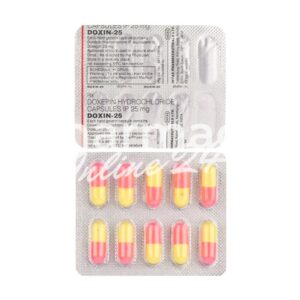
In brief
- Doxepin (Sinequan) is a prescription-only medicine (POM) in the UK; supply is via a pharmacy with a valid prescription.
- Sinequan (doxepin) is used for depression and anxiety; it is a tricyclic antidepressant that non-selectively inhibits reuptake of serotonin and noradrenaline and has strong antihistaminic and anticholinergic effects.
- Usual dosage: for depression/anxiety start around 75 mg/day (divided or at night), typical range 75–150 mg/day with doses up to 300 mg/day in some cases; lower starting doses advised for elderly and in hepatic/renal impairment; not recommended for children under 12.
- Form of administration: oral capsules (10, 25, 50, 75 and 100 mg).
- Onset time: sedative/antihistamine effects usually begin within 30–60 minutes; antidepressant effects typically take 1–3 weeks to become apparent.
- Duration of action: sedation commonly lasts 6–8 hours; doxepin has an elimination half-life roughly 8–24 hours so pharmacological effects persist with daily dosing and antidepressant benefit requires ongoing therapy.
- Alcohol warning: avoid alcohol while taking doxepin — alcohol markedly increases sedation and respiratory/cognitive depression and can worsen other side effects.
- The most common side effect is drowsiness (sedation); other frequent effects include dry mouth, dizziness, blurred vision, constipation, urinary retention, weight gain and orthostatic hypotension — seek immediate care for cardiac arrhythmias, seizures or severe rash.
- Would you like to try Sinequan without a prescription?
Legal status and availability in the UK
In our online pharmacy, Sinequan is available without a prescription, with discreet delivery to the United Kingdom in 9–21 days.
Sinequan (doxepin) is a prescription-only medicine (POM) in the UK.
Basic Sinequan information
- INN (international nonproprietary name): Doxepin.
- Brand names available in the United Kingdom: Sinequan; generic doxepin
- ATC code: N06AA12
- Forms and dosages: capsules 10, 25, 50, 75 and 100 mg
- Manufacturers in the United Kingdom: Mylan, Teva and other generic manufacturers
- Registration status in the United Kingdom: Prescription-only medicine (POM)
- OTC / Rx classification: Prescription-only medicine (POM)
Doxepin is a tricyclic antidepressant (ATC code N06AA12). In the UK, it is prescription-only and regulated by the MHRA.
Indications, who it’s for and contraindications
Indications and absolute contraindications
What conditions is doxepin indicated for and who should never take it?
Primary indications include major depressive disorder and anxiety-related depression.
Absolute contraindications are: known doxepin or tricyclic antidepressant hypersensitivity, narrow-angle glaucoma, urinary retention, and recent MAOI use within the past 14 days.
Relative contraindications include advanced age, significant cardiac conduction disease or arrhythmias, severe hepatic or renal impairment, severe prostatic hypertrophy, and a history of suicidality.
Pregnancy and lactation are relative contraindications where specialist advice is required and use should be limited to situations where benefits outweigh risks.
Prescribers in the UK must follow MHRA guidance and balance individual risks and benefits, documenting rationale for starting or continuing therapy.
When a contraindication is present, pharmacists should flag and discuss the issue with the prescriber before dispensing.
Formulations and strengths
Doxepin is supplied as capsules in strengths of 10, 25, 50, 75 and 100 mg.
| Form | Strengths (mg) |
|---|---|
| Capsules | 10, 25, 50, 75, 100 |
Standard dosing by condition and titration
Practical dosing guidance
How is doxepin started and adjusted in everyday practice?
For adults with depression or anxiety, a common starting dose is around 75 mg per day, taken either divided or at night, with a usual range of 75–150 mg/day and doses up to 300 mg/day for severe cases.
Children under 12 are not recommended to use doxepin, and adolescents should be treated with the lowest effective dose and close monitoring.
Elderly patients are more sensitive to anticholinergic and sedative effects, so start low (for example 25–50 mg/day) and titrate carefully.
Hepatic or renal impairment necessitates reduced starting doses and slower titration with monitoring of effects and side effects.
Example titration steps: start 25–50 mg/day, reassess at 1 week for sedation and orthostasis, then increase by 25–50 mg every 1–2 weeks until response or limit tolerated dose.
Monitor blood pressure, heart rate and anticholinergic burden during titration, and document any dose changes for repeat prescribing.
Practical advice when starting treatment
What patients should know
What should be covered at the first supply so patients start safely?
Advise patients about prescription status, expected onset of antidepressant effect (often 1–3 weeks), and common early effects such as sedation and dry mouth.
Explain the action for missed doses: take as soon as remembered unless the next dose is due, and do not double doses to catch up.
Counsel patients to avoid alcohol and to be cautious with driving or operating machinery until they know how doxepin affects them.
For elderly or cardiac comorbidity, recommend baseline ECG where appropriate and a medicines review for QT‑prolonging agents.
Symptoms to report include urinary retention, severe dizziness, chest pain or worsening mood. Review tolerability and side effects with the prescriber or pharmacist after 1–2 weeks.
Drug interactions and concomitant medicines
Key interactions to flag
Which drug combinations are high risk and require action?
MAOI use within the previous 14 days is absolutely contraindicated due to the risk of severe interactions.
Concomitant serotonergic drugs increase the risk of serotonin syndrome and should be co‑prescribed only with careful clinical review.
Anticholinergic agents such as some antihistamines and antipsychotics add to dry mouth, constipation, urinary retention and confusion risks.
Caution is required with QT‑prolonging drugs and with CNS depressants such as benzodiazepines, opioids and alcohol because of additive sedation and respiratory depression.
Doxepin is metabolised partly by CYP enzymes and interacting drugs that inhibit CYP2D6 or CYP2C19 (for example fluoxetine, paroxetine) may increase plasma doxepin concentrations and require dose adjustments or monitoring.
Perform medicines reconciliation for other antidepressants, antipsychotics and antiarrhythmics, and consult the prescriber about strong CYP inhibitors or inducers.
- High-risk drugs: MAOIs — do not co‑prescribe.
- Monitor/adjust: SSRIs that inhibit CYP2D6, QT‑prolonging agents, strong CYP inhibitors.
Side-effect profile, monitoring and minimising risk
Common vs serious effects and monitoring plan
What side effects should patients expect and which require urgent care?
Common adverse effects include drowsiness, dry mouth, dizziness, blurred vision, constipation, urinary retention, weight gain and orthostatic hypotension.
Serious but less frequent risks are cardiac arrhythmias, seizures and severe anticholinergic effects; any sudden chest pain, palpitations or loss of consciousness needs urgent assessment.
Baseline monitoring should include blood pressure, heart rate and orthostatic vitals, and an ECG for patients with existing cardiac risk factors.
Mood and suicidality checks are important during the first 4–12 weeks after starting or changing dose.
For elderly patients perform a fall‑risk assessment and arrange medication review at each change in therapy.
Simple strategies to reduce risk include starting low, dosing at night to limit daytime sedation, advising hydration for dry mouth and a bowel regimen to prevent constipation.
| Symptom | Frequency | Management |
|---|---|---|
| Drowsiness | Common | Take at night, avoid driving until effects known |
| Dry mouth | Common | Oral hygiene, sugar-free lozenges, maintain hydration |
| Orthostatic hypotension | Common | Monitor BP, rise slowly from sitting/lying |
| Cardiac arrhythmia | Uncommon/Serious | Stop drug and seek urgent review; obtain ECG |
Overdose, missed dose and withdrawal
Emergency and routine advice
What should patients and carers do in an emergency or for routine missed doses?
Overdose with doxepin can cause severe drowsiness, confusion, cardiac arrhythmias and seizures and requires immediate medical attention and emergency services notification of possible TCA toxicity.
Management of overdose is supportive and carried out in hospital settings with monitoring and symptomatic treatment.
For a missed dose, take it as soon as remembered unless it is close to the next planned dose, and do not double up doses.
When stopping treatment, a gradual taper is recommended to reduce withdrawal symptoms and rebound depression; the taper schedule should be tailored to the current dose and treatment duration.
Carers should be advised to monitor mood closely and watch for increased suicidal thoughts during initiation, dose changes and withdrawal.
Storage and handling
Safe storage
How should doxepin be stored?
Store doxepin at room temperature, generally 15–30°C, protected from moisture and excessive heat.
Keep it in the original packaging so that the labelling and batch information are preserved.
Return unused medicine to a pharmacy take‑back scheme rather than flushing it away.
Comparative positioning vs alternatives
When doxepin is chosen over SSRIs or other TCAs
Why might a clinician choose doxepin instead of an SSRI or another tricyclic?
Doxepin is chosen when sedative antidepressant properties are desirable, for example depressed patients with prominent insomnia or anxiety‑related sleep disturbance.
SSRIs such as sertraline and fluoxetine are generally first‑line for depression because of more favourable tolerability profiles, but doxepin can be effective when SSRIs are not tolerated or effective.
Comparable TCAs include amitriptyline, nortriptyline and imipramine; choice depends on comorbidities, side‑effect profiles and cardiac risk.
| Drug | Strength | Typical use | Notable risks |
|---|---|---|---|
| Doxepin | 10–100 mg capsules | Depression, anxiety | Anticholinergic effects, sedation, cardiac risk |
| Sertraline | 25–200 mg | First‑line depression/anxiety | GI upset, sexual dysfunction |
| Amitriptyline | 10–150 mg | Pain, depression, insomnia (low doses) | High anticholinergic burden, sedation |
Regulatory, prescribing and legal notes
Prescribing, reporting and special populations
What legal checks and reporting obligations apply to doxepin in the UK?
Doxepin is prescription-only and prescribers should document risk/benefit, especially for older adults and those with cardiac disease.
Report suspected adverse reactions via the MHRA Yellow Card scheme to ensure ongoing pharmacovigilance.
Pregnancy and breastfeeding require specialist advice and doxepin should only be used if clearly needed after risk assessment.
Ensure labelling and patient counselling include the contraindication for MAOI use within 14 days and warnings about driving and alcohol.
Pharmacists must not supply doxepin without a valid prescription and may accept electronic prescriptions and NHS repeat systems where applicable.
Delivery across the United Kingdom
| City | Region | Delivery Time |
|---|---|---|
| London | England | 9–21 days |
| Birmingham | England | 9–21 days |
| Manchester | England | 9–21 days |
| Glasgow | Scotland | 9–21 days |
| Edinburgh | Scotland | 9–21 days |
| Leeds | England | 9–21 days |
| Liverpool | England | 9–21 days |
| Bristol | England | 9–21 days |
| Sheffield | England | 9–21 days |
| Newcastle | England | 9–21 days |
| Nottingham | England | 9–21 days |
| Belfast | Northern Ireland | 9–21 days |
| Cardiff | Wales | 9–21 days |
| Coventry | England | 9–21 days |