Rybelsus
In stock
3mg · 7mg · 14mg
from 156,24 £
In brief
- Rybelsus provides semaglutide, a GLP-1 receptor agonist, as a daily tablet for adults whose type 2 diabetes needs more than diet and exercise.
- Three strengths are offered (3 mg, 7 mg and 14 mg), each in packs of 10, 20, 30, 60 or 90 tablets.
- It is a POM; in the UK the 3, 7 and 14 mg tablets belong to an earlier formulation that has been replaced by 1.5, 4 and 9 mg.
Rybelsus: semaglutide that is swallowed, not injected
Rybelsus answers a long-standing limitation: semaglutide is normally given as an injection. In Rybelsus it is combined with salcaprozate sodium, a substance that helps a small share of each dose cross the stomach lining. Semaglutide copies GLP-1, a gut hormone that prompts the pancreas to release insulin when blood glucose is high, restrains glucagon and slows stomach emptying. Since so little is absorbed, how the tablet is taken makes a real difference. With a half-life of about a week, one tablet a day is sufficient. It suits people who would rather avoid injections, although it remains a prescription-only medicine with rules of its own.
The intended patients
The intended patients are adults whose type 2 diabetes stays above target despite diet and exercise. For people who cannot use metformin it can serve as the sole glucose-lowering medicine; otherwise it is added to existing diabetes treatment, insulin included. The SmPC offers nothing for type 1 diabetes or for diabetic ketoacidosis.
Earlier tablets and the current UK range
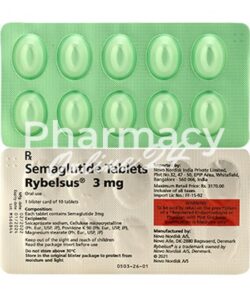
When Rybelsus first reached the UK it came as 3 mg, 7 mg and 14 mg tablets, and the electronic medicines compendium now marks that version as discontinued. A reformulated tablet has taken over in strengths of 1.5 mg, 4 mg and 9 mg, intended to replace the old ones in order: Pairing them in turn, the 3 mg tablet is succeeded by 1.5 mg, the 7 mg by 4 mg and the 14 mg by 9 mg. Because the numbers differ even though the effect should be the same, a prescriber or pharmacist must say which strength to use when someone changes series; comparing milligrams is not enough. The tablets on this page are imported.
The dose steps
Treatment starts with 3 mg once a day for 30 days, a gentle introduction for the gut. After that the dose is 7 mg. If glucose is still above target following at least another month, 14 mg is the top step. Never more than one tablet is taken in a day; the SmPC says that replacing a stronger tablet with two weaker ones has not been studied and is not advised. A missed dose is skipped. Age and kidney function do not change the dose. When insulin or a sulfonylurea is used as well, those may be lowered to prevent hypoglycaemia.
Swallowing the tablet the right way
On waking, with an empty stomach, the tablet goes down whole with a small amount of plain water, at most 120 ml or half a glass. For the next 30 minutes nothing else should go in: no food, no drink, no other oral medicine. Leave it in the foil blister until it is time to swallow it, as the packaging protects the tablet from light and moisture. Thyroid tests may be repeated because exposure to levothyroxine can increase, and warfarin users might need more frequent INR checks at the beginning.
Safety points and side effects
The only contraindication is hypersensitivity, but use is not recommended in NYHA class IV heart failure; the SmPC advises care in pancreatitis, diabetic retinopathy among insulin users, gastroparesis, previous bariatric surgery and dehydration, and the anaesthetist should know about the tablets before any procedure. Women who could become pregnant are advised to use effective contraception. Semaglutide must be stopped at least two months before a planned pregnancy, and it should not be used while breastfeeding. Nausea and diarrhoea affect more than ten in a hundred people, and hypoglycaemia is equally frequent when insulin or a sulfonylurea is part of the regimen. Tiredness, headache, dizziness, vomiting, abdominal pain, bloating, constipation, heartburn, wind and reduced appetite are also common. Uncommon reactions include gallstones, belching, a change in taste and a quicker heartbeat, with pancreatitis and anaphylaxis rare. Whether Rybelsus belongs in a diabetes plan is the prescriber’s judgement.