Betamethasone valerate
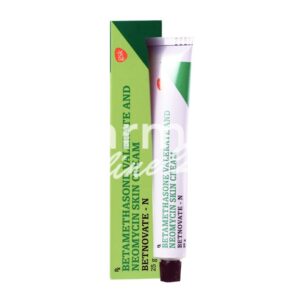
In stock
0,1%
from 2,24 £
In brief
- Betamethasone valerate is a strong topical corticosteroid, spread thinly over skin to bring down eczema and other inflamed, itchy rashes.
- One 0.1% cream is listed; the choice is how many tubes to buy, from 1, 3, 5, 7, 9 or 12.
- In the UK it requires a prescription, and Betnovate and a generic 0.1% cream are licensed; the cream here is imported.
What kind of steroid is betamethasone valerate?
Betamethasone valerate belongs to the potent group of topical steroids, a ranking by strength that dermatologists use. It is stronger than hydrocortisone or clobetasone butyrate, and weaker than the very potent group. On the skin it acts by calming the local immune reaction behind redness, swelling and itch. The cream form glides on easily and is a fair match for moist or weeping patches, while ointments, which are greasier, tend to be chosen for dry and scaly skin.
What the SmPC says it is for
Itchy, inflamed skin conditions that respond to a corticosteroid are what the Betnovate cream SmPC covers. Examples are the various types of eczema, contact dermatitis, psoriasis, lichen planus and discoid lupus erythematosus. The cream is intended to settle a flare, after which the amount used is stepped down and a plain emollient often continues the work. Only a thin film of betamethasone valerate is needed; applying more gives no extra effect and simply sends more steroid into the body.
Tubes, quantities and the usual course
Neither the size of each tube nor the basis of the 0.1% figure (base or ester) is stated in the listing. In adults the SmPC describes a thin layer once or twice daily for up to four weeks, followed by a reduction. A moisturiser may be used after the cream has soaked in. If a patch keeps coming back, maintenance treatment consists of an uncovered application once daily on two days each week. Clinical reassessment is appropriate at two to four weeks. Use on the face, and in children under 12, is limited to five days with no sealing dressings. Following a long course, the dose is tapered, because abrupt withdrawal can trigger a rebound.
Skin it must stay away from
A steroid can let an infection that has not been treated spread across the skin. Rosacea, acne, perioral dermatitis, itching with no visible rash and anal or genital itching are other reasons to avoid the cream, as is an age under one year. Take care near the eyes: steroid getting into them has been linked with cataract and glaucoma. A nappy increases absorption. Clothing, dressings or bedding that have been in contact with the cream may burn more readily, so naked flames and smoking are to be avoided.
When the steroid is absorbed
A sufficient amount absorbed through the skin can suppress the adrenal glands and produce Cushingoid changes. Large treated areas, occlusive dressings and long courses raise the likelihood. Ritonavir, itraconazole and other CYP3A4 inhibitors delay the breakdown of corticosteroids, so exposure from a given amount of cream is higher.
Skin and eye reactions
Most often the cream itself irritates, with itching, burning or pain on the treated patch. Prolonged or heavy use can leave skin thinner, with stretch marks, visible small vessels, patchy colour change and extra hair growth. Allergy to the cream and pustular psoriasis may also occur. Blurred vision should be mentioned to a doctor, since cataract or glaucoma is a possible cause, and red, burning skin after a steroid is stopped is recognised as topical steroid withdrawal.
Licensing in Britain
The prescriber, not the patient, chooses the strength, treated area and duration for Betamethasone valerate, and should hear if the skin is no better after about a month. Betamethasone valerate in this form is prescription-only in Britain. On the licensed side, Betnovate is made as a cream, ointment, lotion, scalp application and RD dilutions, while generic betamethasone valerate 0.1% w/w cream is marketed as well. The tubes offered here are imported and not UK-labelled, so keep the carton and leaflet. Stopping a long course without advice is unwise, as the original condition may return in a worse form.