Fluoxetine
In brief
- In our pharmacy, you can buy fluoxetine without a prescription, with delivery in 9–21 days throughout the United Kingdom. Discreet and anonymous packaging.
- Fluoxetine is used to treat major depressive disorder, obsessive–compulsive disorder and bulimia nervosa; it is a selective serotonin reuptake inhibitor (SSRI) that increases serotonin availability in the brain by blocking the serotonin transporter.
- The usual dose of fluoxetine for adults is 20 mg once daily (depression usually 20 mg daily; OCD and bulimia nervosa may need up to 60 mg/day); lower starting doses (e.g. 10 mg) may be used in children or the elderly and dose adjustments are guided by clinical response.
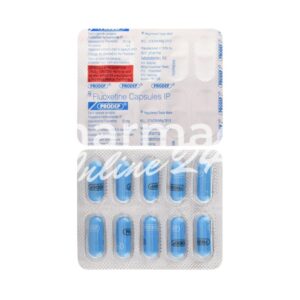
- The form of administration is oral: capsules (20 mg and 60 mg), dispersible tablets (20 mg) and an oral liquid (20 mg/5 mL).
- The effect begins to be noticed in some patients within 1–2 weeks (early side effects often occur sooner), but meaningful antidepressant or anxiolytic benefit typically takes 4–6 weeks.
- The duration of action is prolonged: fluoxetine has a long elimination half-life (fluoxetine approximately 2–4 days, its active metabolite norfluoxetine about 7–15 days), so effects persist for days to weeks after dosing.
- Avoid or limit alcohol while taking fluoxetine, as alcohol can worsen mood symptoms and increase sedative effects or other adverse reactions.
- The most common side effect is nausea.
- Would you like to try fluoxetine without a prescription?
Basic fluoxetine information
- INN (international nonproprietary name): Fluoxetine
- Brand names available in the United Kingdom: Prozac; generic fluoxetine
- ATC code: N06AB03
- Forms and dosages: capsules 20 mg and 60 mg; dispersible tablets 20 mg; oral liquid 20 mg/5 mL
- Manufacturers in the United Kingdom: Eli Lilly (Prozac) and several generic manufacturers
- Registration status in the United Kingdom: Licensed by the MHRA; prescription-only medicine
- OTC / Rx classification: Prescription-only medicine (POM)
Adherence and expectations
Patients often stop treatment early because they expect immediate results or cannot tolerate early side effects.
Fluoxetine’s long half-life helps reduce worry about missed doses, but it can also prolong side effects if they occur.
Younger patients and caregivers frequently ask about suicidality risks and monitoring, and clinicians should address these concerns directly.
For bulimia and OCD, patients should be counselled that symptom-specific improvements may require higher doses or longer treatment.
Licensed indications
Fluoxetine is MHRA-licensed for major depressive disorder, obsessive–compulsive disorder, bulimia nervosa and some anxiety presentations in adults.
Age-specific guidance applies to children and adolescents, and initiation in younger patients requires careful monitoring.
When clinicians favour fluoxetine
Clinicians may choose fluoxetine when a long half-life is desirable to reduce withdrawal risk on missed doses.
Fluoxetine is commonly selected for patients with comorbid bulimia or when previous good response to fluoxetine has been documented.
In primary care it is often a first- or second-line SSRI depending on clinical features and comorbidities.
- Licensed indications: Major depressive disorder; Obsessive–compulsive disorder; Bulimia nervosa; Selected anxiety disorders.
| Use case | Fluoxetine | Other SSRIs |
|---|---|---|
| Bulimia | Often preferred | Less evidence for high-dose effect |
| OCD | Effective; higher doses may be used | Sertraline also commonly used |
| Depression | Standard option | Sertraline, citalopram commonly used |
Prescriber Note: MHRA licensing should be checked and a risk assessment for suicidality is required for under-25s.
Formulations sold in UK
In the UK fluoxetine is usually available as generic tablets or capsules and as an oral solution where needed for dose flexibility.
Common tablet strengths include 10 mg and 20 mg, and liquid concentrations such as 20 mg per 5 mL are sometimes used.
Branded products include Prozac and multiple generics from well-known manufacturers.
Typical packaging and labelling
Packaging normally includes an outer carton, a patient information leaflet and either blister packs for tablets or pharmacy-labelled bottles for liquids.
Patients should verify batch number, expiry date and licence information when supplied with branded packs.
| Form | Strength | Common pack sizes |
|---|---|---|
| Tablet/Capsule | 10 mg, 20 mg | 28, 56, 84 |
| Oral Solution | 20 mg/5 mL | 100 mL bottles |
- Checklist for patients: Verify strength and expiry.
- Checklist for patients: Read the patient information leaflet before starting.
- Checklist for patients: Inspect packaging for damage and confirm pharmacy dosing sticker.
Prescription classification
Fluoxetine is a Prescription-Only Medicine (POM) across the United Kingdom.
Supply must follow UK regulatory rules and MHRA guidance.
Availability in the UK
In our online pharmacy, fluoxetine is available without a prescription, with discreet delivery to the United Kingdom in 9–21 days.
Starting doses and titration
Typical adult starting dose is 20 mg once daily, usually taken in the morning.
Some clinicians advise taking the dose at night if early activation or insomnia occurs.
For OCD or bulimia higher doses — for example up to 60 mg daily — may be required under specialist supervision.
Titration should be gradual with clinical review to assess tolerability and response.
Switching from other antidepressants
Fluoxetine’s long half-life and active metabolite mean steady state and clearance are slow compared with many SSRIs.
A washout period is required before starting an MAOI; a gap of five weeks is commonly advised after fluoxetine before initiating an MAOI.
When switching between SSRIs clinicians may use either a direct switch or a cross-taper depending on clinical circumstances.
- Start: 20 mg once daily.
- Review: 2–4 weeks for side effects and early response.
- Consider uptitration: 4–6 weeks if partial response.
Definition: steady state – when drug intake and elimination balance out and plasma levels stabilise.
Definition: washout period – the time needed for a drug to fall to levels considered safe before starting another interacting medicine.
Warning: Interactions with MAOIs and pimozide require specialist input.
When patients feel better
Antidepressant benefits often begin around two to four weeks with meaningful change by six to eight weeks for many patients.
Full remission may take longer, and individual response varies.
For OCD and bulimia improvements can be delayed and higher doses are sometimes needed.
Monitoring schedule for safety and efficacy
Initial review at two weeks should focus on side effects and any emergence of suicidal thoughts.
Efficacy review is recommended at four to six weeks with further checks every three months once stable.
Children, adolescents and young adults require more frequent monitoring and safety-netting.
- Monitoring checklist: Mood and suicidal ideation.
- Monitoring checklist: Sleep, appetite and sexual function.
- Monitoring checklist: Adherence and side-effect burden.
Common adverse effects and mitigation
Common side effects include nausea, headache, insomnia or daytime sleepiness, anxiety, sweating and gastrointestinal upset.
Many side effects settle within one to four weeks as the body adjusts.
Simple measures such as taking medication with food or changing dosing time can reduce some effects.
Serious risks and red flags
Serious but uncommon risks include increased suicidal thoughts in under-25s and serotonin syndrome when combined with other serotonergic agents.
Hyponatraemia is a concern in older adults and with certain comorbidities.
Combination with NSAIDs, antiplatelets or anticoagulants may increase bleeding risk.
| Frequency | Events |
|---|---|
| Common (≥1%) | Nausea, headache, insomnia, anxiety, sweating |
| Uncommon | Sexual dysfunction, increased agitation |
| Rare/Serious | Suicidal ideation in under-25s, serotonin syndrome, hyponatraemia |
Red flags (urgent): New or worsening suicidal thoughts, signs of serotonin syndrome such as agitation, rapid heart rate, high temperature and muscle rigidity.
Encourage reporting of adverse reactions via the Yellow Card scheme.
High-risk interactions
Concurrent MAOI use is contraindicated due to the risk of serotonin syndrome.
Fluoxetine inhibits CYP2D6 and can interact with tricyclics, some antipsychotics and tamoxifen, reducing its activation.
SSRIs increase bleeding risk when combined with NSAIDs, antiplatelets or anticoagulants.
QTc effects are generally modest, but use caution when combining with other QT-prolonging drugs.
Contraindications and caution flags
Known hypersensitivity to fluoxetine is an absolute contraindication.
Recent MAOI therapy requires an appropriate washout period before fluoxetine is started.
Exercise caution with severe hepatic impairment and in older patients because of altered pharmacokinetics and hyponatraemia risk.
| Drug/class | Interaction effect | Action required |
|---|---|---|
| MAOIs | Risk of serotonin syndrome | Contraindicated; observe washout period |
| Tamoxifen | Reduced activation of tamoxifen | Consider alternative SSRI or oncology advice |
| NSAIDs/Anticoagulants | Increased bleeding risk | Monitor and consider gastroprotection |
Definitions: CYP2D6 inhibitor – a drug that reduces metabolism of other medicines by inhibiting CYP2D6 enzymes.
Definitions: serotonin syndrome – an emergency caused by excess serotonergic activity.
Age-specific guidance
For children and adolescents fluoxetine is among the SSRIs considered in some guidelines, but specialist input and close monitoring are essential.
Start with lower doses and arrange frequent reviews for younger patients.
The elderly are more vulnerable to hyponatraemia, falls and drug interactions; start low and review regularly.
Comorbid conditions and monitoring
Pregnancy and breastfeeding require a specialist discussion about risks and benefits because fluoxetine crosses the placenta and transfers into breastmilk.
Hepatic impairment may require dose reduction and specialist involvement.
Renal impairment has less direct effect on fluoxetine clearance than hepatic disease, but monitor comorbidity and concurrent medicines closely.
Shared decision-making and documentation of consent are recommended for higher-risk groups.
- Assess age and pregnancy status → specialist input if pregnant or adolescent → start low and monitor closely.
Key counselling points
Explain the purpose of fluoxetine and set expectations: benefits often start in 2–8 weeks.
Describe common side effects and practical ways to manage them such as taking with food or altering timing.
Warn about urgent symptoms such as suicidal thoughts and serotonin syndrome and advise immediate contact with GP or emergency services.
Advise on missed-dose rules: do not double up; take the next dose as usual.
How to store fluoxetine
Store fluoxetine tablets and liquids at room temperature, protected from moisture and heat.
Keep liquids tightly capped and do not freeze them.
Disposal and returns
Return unused or expired medicines to a pharmacy for safe disposal and do not flush or bin them.
Carry medicines in their original labelled containers when travelling.
How fluoxetine compares to other SSRIs
Fluoxetine’s long half-life reduces abrupt withdrawal risk and is an established option in bulimia treatment.
It can interact via CYP2D6, which is a relative drawback compared with SSRIs that have fewer interactions.
Some patients experience activation or insomnia more with fluoxetine than with sertraline or citalopram.
| Drug | Onset | Half-life | Common consideration |
|---|---|---|---|
| Fluoxetine | 2–4 weeks | Long | Less abrupt withdrawal; CYP2D6 interactions |
| Sertraline | 2–4 weeks | Shorter | Often chosen for comorbid anxiety |
| Citalopram | 2–4 weeks | Moderate | QTc considerations at high doses |
Augmentation options for inadequate response include adding mirtazapine, atypical antipsychotics or switching classes under specialist supervision.
Delivery across the United Kingdom
| City | Region | Delivery time |
|---|---|---|
| London | England | 9–21 days |
| Birmingham | England | 9–21 days |
| Manchester | England | 9–21 days |
| Glasgow | Scotland | 9–21 days |
| Leeds | England | 9–21 days |
| Sheffield | England | 9–21 days |
| Bristol | England | 9–21 days |
| Liverpool | England | 9–21 days |
| Edinburgh | Scotland | 9–21 days |
| Cardiff | Wales | 9–21 days |
| Belfast | Northern Ireland | 9–21 days |
| Newcastle | England | 9–21 days |
| Nottingham | England | 9–21 days |
| Leicester | England | 9–21 days |
| Southampton | England | 9–21 days |